• Welcome to the Internet Infidels Discussion Board.

MCATs, Affirmative Action, and DEI, Oh My

The local situation is much more sensibly explained by hypothesizing
You are unspeakably confused about the very nature of the scientific method. Like, at a primary school level. It doesn't matter what followed that phrase, nothing could have made that sentence scientifically sound.
Nothing wrong with my understanding of science. What's wrong is with your understanding of what's been proven.
I think what is wrong is that no one but you knows what exactly you are talking about, including what you think has been alleged and what you think has been "proven". There is a vast cloud of opaqueness in your posts on this subject.
 
study said:
There are a couple ways to look at this.

1) OMFG!!! Blacks drop out about 250% more than whites!!! OMFFFFFGGFG!
2) Out of 1000 people, 977 whites don't drop out and 943 blacks don't drop out.

With these numbers, it makes one wonder, the importance of the MCAT other than being a basic screening tool.
The 250% is the relevant number. The other is being deceptive.
The "other" is the molehill, the 250% is the mountain.
 
This site is interesting:
A bit old, but yes.

Section you didn't quote:
Tiber MSMS said:
The MCAT Seems to Be Good at Predicting Academic Ability Early in Medical School
While the MCAT favors wealthier students, it does appear that students who achieve high scores on the MCAT, regardless of background, are likely to complete medical school. A 2013 study found that students with strong MCAT scores and GPAs at admission were more likely to experience “unimpeded progress” through medical school, meaning:

They were not dismissed for academic reasons
They did not withdraw for academic reasons
They graduated within five years of beginning medical school
They passed each step of the US Medical Licensing Exam (USMLE) on the first attempt
Further evidence supports this: the AAMC reports that 98 per cent of first-year medical students who scored in the average range (510-513) on the MCAT in 2019 progressed to their second year. However, so did 94 per cent of those with scores 10 points below the average (496-501).
So, MCAT scores predict success in med school. And while this website downplays the differences in retention rate, 2% vs 6% dropout means that low MCAT scorers have triple the risk of failing med school in the first year. That is a very significant difference. And due to lower MCAT scores of black, Hispanic and American Indian matriculants, far more of them fall into the dangerous 496-501 category.
MCAT Success Doesn’t Seem to Translate to Clinical or Residency Success
That heading doesn't quite fit what's below.
- Associated with success on the USMLE step 1, the USMLE step 2 clinical knowledge exam, and the USMLE step 3
- Somewhat linked to higher GPAs during medical school
So, an objective measure used for med school admissions is associated with objective measures in med school.
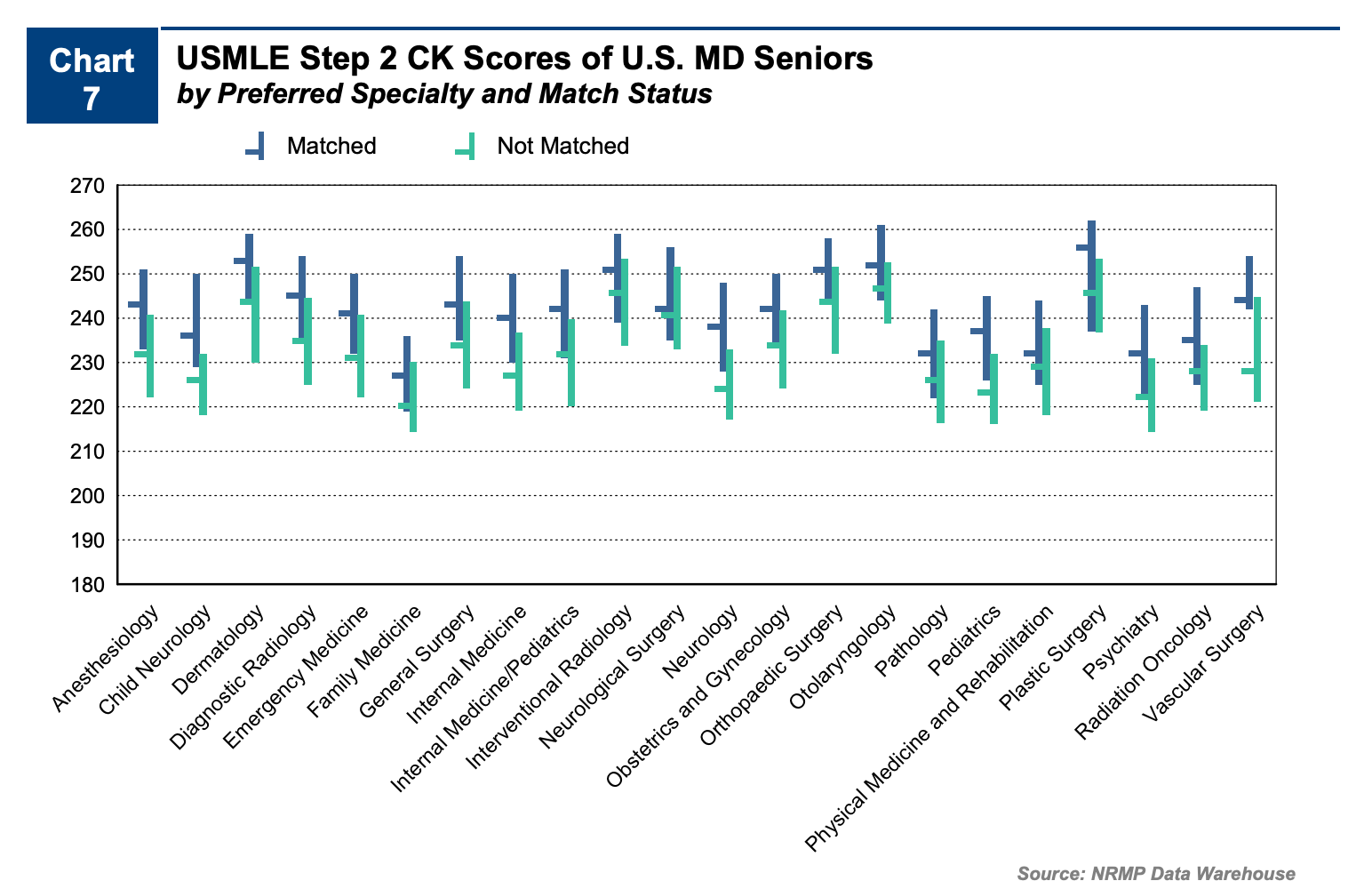
Since AAMC foolishly decided to make Step 1 pass/fail, Step 2 is now the single most important metric for residency selection.
Not consistently associated with success in clinical-based evaluations during the last two “clerkship” years of medical school, including the USMLE step 2 clinical skills evaluation
Clinical evals are subjective, and so it makes sense that MCAT is less associated with those.
Step 2 CS is no more - another casualty of COVID19.
Not associated with success on clinical evaluations during the first year of residency after graduating from medical school[/U]
Again, clinical evals are subjective. What about objective measures, like the ABSITE exam for surgery residents?
And again, MCAT success is associated with success on the USMLE Step 2 CK, which is very important for getting into the residency you want.

step2CK-score.png
 
Last edited:
This part shows what's going on--as always, race is just a proxy for background. The problem is there's no reason to think that background doesn't have the same effect on medical school as it has on medical school admissions.

I agree with the first part of what you are saying, but I don't think the "background" is entirely correlated to race. Preparation time is likely a little bit more independent than other variables, in my opinion. It's difficult to say for sure since we do not see statistics for this.
Proxies are not perfect matches--you identify proxies by looking for what variables you can remove from your model without reducing your accuracy. (Take the classic ice cream/rape relationship. Add a third factor to the model: weather. Run three models, ice cream, weather, ice cream + weather. The third does no better than the second, thus you drop ice cream.) And I wasn't even thinking it was directly correlated. Rather preparation time is a function of socioeconomic status and culture (how much is education stressed?) And socioeconomic status is correlated with race.
 
‘Background’ is a close proxy for socioeconomic class which is also correlated with education attainment of the parents.
So?
This is why a lot of schools are placing a lower emphasis on SATs. Plus fewer college age prospective students.
Except they have found that other metrics are easier to game.
 
This site is interesting:
A bit old, but yes.

Section you didn't quote:
Tiber MSMS said:
The MCAT Seems to Be Good at Predicting Academic Ability Early in Medical School
While the MCAT favors wealthier students, it does appear that students who achieve high scores on the MCAT, regardless of background, are likely to complete medical school. A 2013 study found that students with strong MCAT scores and GPAs at admission were more likely to experience “unimpeded progress” through medical school, meaning:

They were not dismissed for academic reasons
They did not withdraw for academic reasons
They graduated within five years of beginning medical school
They passed each step of the US Medical Licensing Exam (USMLE) on the first attempt
Further evidence supports this: the AAMC reports that 98 per cent of first-year medical students who scored in the average range (510-513) on the MCAT in 2019 progressed to their second year. However, so did 94 per cent of those with scores 10 points below the average (496-501).
So, MCAT scores predict success in med school. And while this website downplays the differences in retention rate, 2% vs 6% dropout means that low MCAT scorers have triple the risk of failing med school in the first year. That is a very significant difference. And due to lower MCAT scores of black, Hispanic and American Indian matriculants, far more of them fall into the dangerous 496-501 category.

MCAT Success Doesn’t Seem to Translate to Clinical or Residency Success​

That heading doesn't quite fit what's below.
- Associated with success on the USMLE step 1, the USMLE step 2 clinical knowledge exam, and the USMLE step 3
- Somewhat linked to higher GPAs during medical school
So, an objective measure used for med school admissions is associated with objective measures in med school.
Since AAMC foolishly decided to make Step 1 pass/fail, Step 2 is now the single most important metric for residency selection.
I wonder what "associated with success" and "somewhat linked" means. Sounds pretty mealy mouthed to me.

In your opinion, is a grade point average an "objective" measure because it is a number or because you believe the grades that make up the average are objective measures?
 
This is why a lot of schools are placing a lower emphasis on SATs. Plus fewer college age prospective students.
Except they have found that other metrics are easier to game.
On what basis do you draw such a conclusion? Do you know someone who works in admissions or know someone who does admissions work in college?
 
study said:
There are a couple ways to look at this.

1) OMFG!!! Blacks drop out about 250% more than whites!!! OMFFFFFGGFG!
2) Out of 1000 people, 977 whites don't drop out and 943 blacks don't drop out.

With these numbers, it makes one wonder, the importance of the MCAT other than being a basic screening tool.
The 250% is the relevant number.
Why?
The other is being deceptive.
How?
Because what's being measured is failure.

It's one of the standard ways of lying with statistics--embed what you want to hide within something much larger.

Why are you taking their side on this? My impression is that you support basically my position--colorblind.
 
- Associated with success on the USMLE step 1, the USMLE step 2 clinical knowledge exam, and the USMLE step 3
- Somewhat linked to higher GPAs during medical school
So, an objective measure used for med school admissions is associated with objective measures in med school.
Since AAMC foolishly decided to make Step 1 pass/fail, Step 2 is now the single most important metric for residency selection.
I wonder what "associated with success" and "somewhat linked" means. Sounds pretty mealy mouthed to me.
Exactly. Mealy mouthed. As in they don't want to admit the relationship. Just choose a high p threshold, weasel when it's not met. Presto, a way to deny the relationship.
 
study said:
There are a couple ways to look at this.

1) OMFG!!! Blacks drop out about 250% more than whites!!! OMFFFFFGGFG!
2) Out of 1000 people, 977 whites don't drop out and 943 blacks don't drop out.

With these numbers, it makes one wonder, the importance of the MCAT other than being a basic screening tool.
The 250% is the relevant number.
Why?
The other is being deceptive.
How?
Because what's being measured is failure.
That is spin. It is apso measuring success. And at collegiate scales, the difference isn't particularpy relevant, minusing the apparent relationship between economic hardship and becoming a doctor.
Why are you taking their side on this? My impression is that you support basically my position--colorblind.
Your position is obsessed with race.

The bigger point of the data is that it implies that variation in MCAT scores are NOT particularly indicative of success in Medical School.
 
Why are you taking their side on this? My impression is that you support basically my position--colorblind.
Why do you imagine that I am taking any "side" in this?

I am just pointing out the abuse of statistics by pretty much everyone here.

You don't get a pass, or special treatment.
 
The local situation is much more sensibly explained by hypothesizing
You are unspeakably confused about the very nature of the scientific method. Like, at a primary school level. It doesn't matter what followed that phrase, nothing could have made that sentence scientifically sound.
Nothing wrong with my understanding of science. What's wrong is with your understanding of what's been proven.

The observed data was banks were less likely to write low-down mortgages in black neighborhoods. That doesn't prove why. They automatically assumed this was discrimination without attempting to investigate. But let's look at the possibilities.

1) Discrimination. But explain why all the banks do it (none sees an underserved market to exploit), explain why they only do it on low-down mortgages (why is there no such evidence of discrimination against other blacks.) No effort was even made to explain why this pattern existed.

or

2) Banks don't like underwater loans. The map of "discrimination" was basically the same map of price appreciation. Simple, makes good business sense, explains everything.

Which is more likely to be correct?
It makes no difference to the community being denied loans whether there is a "logical argument" for being discriminated against. They are still being systematically turned down for loans, whether the bank manager is secretly a Klan member or has three black friends and listened to a hip hop album once.

The map of "discrimination" was basically the same map of price appreciation.
That is exactly the problem, and everyone involved knows that. You're not breaking anyone's mind by observing that ghettoized Black neighborhoods in the US are almost universally poorer than whatever mainly white neighborhoods adjoin them, for a whole host of reasons from historical housing covenants, to employment discrimination, to systemic denial of city services, to, yes, loan discrimination.

Add a factor to the equation: what are the odds this mortgage will be underwater a few years down the road? Simple, makes good business sense, explains everything.
Unless the public loses patience with race discrimination in banking and either boycotts the bank or seizes control of bank regulation, at which point it becomes a deeply unwise business decision. People don't want an "explanation", they want fucking houses. If you had any common sense you'd understand why, it's not that complicated.

And you're also, as usual, purposefully ignoring the mountains of evidence that race discrimination and class discrimination, though often found together, are not always found together. Is it better to be a rich Black man than a poor Black man? Yes, and for obvious reasons. But that doesn't change the fact that severe race discrimination takes place in banking environments, even for the very wealthy.

 
Even when it doesn't make sense--look at the flap about redlining around the turn of the century. Really, now, you expect me to believe bankers--all bankers--are only discriminating against blacks in black neighborhoods who want low down mortgages???
So to be a "pure scientist" you have to just straight up ignore all evidence that's in front of you? Throw out any data that match your bullshit rhetoric? That's science?

Redlining was LAW. Black-and-white, clear as day. It's only "disputed" now by people who are just as passively racist now as they were when they were letting it happen in the first place.
I'm talking about the findings around 2000, not the stuff from long ago.
Where "a long time ago" is defined as what? Before 20 years ago? What are you, fucking twelve years old?
 
- Associated with success on the USMLE step 1, the USMLE step 2 clinical knowledge exam, and the USMLE step 3
- Somewhat linked to higher GPAs during medical school
So, an objective measure used for med school admissions is associated with objective measures in med school.
Since AAMC foolishly decided to make Step 1 pass/fail, Step 2 is now the single most important metric for residency selection.
I wonder what "associated with success" and "somewhat linked" means. Sounds pretty mealy mouthed to me.
Exactly. Mealy mouthed. As in they don't want to admit the relationship. Just choose a high p threshold, weasel when it's not met. Presto, a way to deny the relationship.
I don't think you are reading posts very closely. You said that the findings that MCAT scores that were associated with success in USMLE step 1, USMLE sept 2 clinical knowledge and USMLE step 3, and that MCAT scores were somewhat linked to higher GPAs in medical school are mealy mouthed findings. In other words, you literally disagreed with Derec's position that MCAT scores are predictors of success in medical school.

As to " p threshold", I assume you refer to the probability of a Type I error in a statistical test. Without stating the null hypothesis, nor knowing the costs of making a Type I or Type II error, the standard of a high p value really doesn't make much sense.
 
study said:
There are a couple ways to look at this.

1) OMFG!!! Blacks drop out about 250% more than whites!!! OMFFFFFGGFG!
2) Out of 1000 people, 977 whites don't drop out and 943 blacks don't drop out.

With these numbers, it makes one wonder, the importance of the MCAT other than being a basic screening tool.
The 250% is the relevant number.
Why?
The other is being deceptive.
How?
Because what's being measured is failure.

It's one of the standard ways of lying with statistics--embed what you want to hide within something much larger.
Another of the standard ways of lying with statistics is to highlight the large percentage difference between two things both of which have a small percentage ocurrence.

A technique you just referred to as producing "the relevant number".

It's relevant to someone supporting your position; Just as Jimmy's equally arithmetically correct alternative (which you called "being deceptive") is relevant to someone opposing your position.

The fact is that both numbers can very well be deceptive. You just don't object to those deceptions that bolster your preconceptions.
 
The local situation is much more sensibly explained by hypothesizing
You are unspeakably confused about the very nature of the scientific method. Like, at a primary school level. It doesn't matter what followed that phrase, nothing could have made that sentence scientifically sound.
Nothing wrong with my understanding of science. What's wrong is with your understanding of what's been proven.

The observed data was banks were less likely to write low-down mortgages in black neighborhoods. That doesn't prove why. They automatically assumed this was discrimination without attempting to investigate. But let's look at the possibilities.

1) Discrimination. But explain why all the banks do it (none sees an underserved market to exploit), explain why they only do it on low-down mortgages (why is there no such evidence of discrimination against other blacks.) No effort was even made to explain why this pattern existed.

or

2) Banks don't like underwater loans. The map of "discrimination" was basically the same map of price appreciation. Simple, makes good business sense, explains everything.

Which is more likely to be correct?
It makes no difference to the community being denied loans whether there is a "logical argument" for being discriminated against. They are still being systematically turned down for loans, whether the bank manager is secretly a Klan member or has three black friends and listened to a hip hop album once.
You are assuming accusation = guilt.
The map of "discrimination" was basically the same map of price appreciation.
That is exactly the problem, and everyone involved knows that. You're not breaking anyone's mind by observing that ghettoized Black neighborhoods in the US are almost universally poorer than whatever mainly white neighborhoods adjoin them, for a whole host of reasons from historical housing covenants, to employment discrimination, to systemic denial of city services, to, yes, loan discrimination.
It also corresponds to the places I would consider least safe. This isn't an arbitrary thing against blacks.

Add a factor to the equation: what are the odds this mortgage will be underwater a few years down the road? Simple, makes good business sense, explains everything.
Unless the public loses patience with race discrimination in banking and either boycotts the bank or seizes control of bank regulation, at which point it becomes a deeply unwise business decision. People don't want an "explanation", they want fucking houses. If you had any common sense you'd understand why, it's not that complicated.
The right keeps preaching fear, fear, fear and you blame the MAGA idiots for listening. But you're preaching discrimination, discrimination, discrimination. The truth doesn't matter.

And you're also, as usual, purposefully ignoring the mountains of evidence that race discrimination and class discrimination, though often found together, are not always found together. Is it better to be a rich Black man than a poor Black man? Yes, and for obvious reasons. But that doesn't change the fact that severe race discrimination takes place in banking environments, even for the very wealthy.

Yeah, racial equality was put before rational business practice.

Thank you for the housing collapse.
 
- Associated with success on the USMLE step 1, the USMLE step 2 clinical knowledge exam, and the USMLE step 3
- Somewhat linked to higher GPAs during medical school
So, an objective measure used for med school admissions is associated with objective measures in med school.
Since AAMC foolishly decided to make Step 1 pass/fail, Step 2 is now the single most important metric for residency selection.
I wonder what "associated with success" and "somewhat linked" means. Sounds pretty mealy mouthed to me.
Exactly. Mealy mouthed. As in they don't want to admit the relationship. Just choose a high p threshold, weasel when it's not met. Presto, a way to deny the relationship.
I don't think you are reading posts very closely. You said that the findings that MCAT scores that were associated with success in USMLE step 1, USMLE sept 2 clinical knowledge and USMLE step 3, and that MCAT scores were somewhat linked to higher GPAs in medical school are mealy mouthed findings. In other words, you literally disagreed with Derec's position that MCAT scores are predictors of success in medical school.

As to " p threshold", I assume you refer to the probability of a Type I error in a statistical test. Without stating the null hypothesis, nor knowing the costs of making a Type I or Type II error, the standard of a high p value really doesn't make much sense.
Doesn't make sense if your objective is knowledge.

But if your objective is to "prove" that the MCAT scores aren't important then it's a very logical approach.
 
if your objective is to "prove" that the MCAT scores aren't important then it's a very logical approach.
I already "proved" that the MCAT scores aren't important (for candidates who achieve or exceed some fairly arbitrary threshold).
You can't have 3 significant digits on an item with only 57 possible values.
I like the way you say this as though it wasn't my entire point. You can express MCAT as a three digit number, but that doesn't imply that there is a useful distinction between a candidate who scores 510 and one who scores 511, or 520.
 
Nothing wrong with my understanding of science. What's wrong is with your understanding of what's been proven.
I think what is wrong is that no one but you knows what exactly you are talking about, including what you think has been alleged and what you think has been "proven". There is a vast cloud of opaqueness in your posts on this subject.

That seems to be Mr Pechtel's normal modus operandii - he assumes that everyone already knows the vast majority of what he is thinking (because he thinks it's obvious), and agrees with it (because he thinks it's true).

I used to do the same. Hell, I still do, though these days I put a lot of effort into trying not to.

It's an ASD thing.
 
- Associated with success on the USMLE step 1, the USMLE step 2 clinical knowledge exam, and the USMLE step 3
- Somewhat linked to higher GPAs during medical school
So, an objective measure used for med school admissions is associated with objective measures in med school.
Since AAMC foolishly decided to make Step 1 pass/fail, Step 2 is now the single most important metric for residency selection.
I wonder what "associated with success" and "somewhat linked" means. Sounds pretty mealy mouthed to me.
Exactly. Mealy mouthed. As in they don't want to admit the relationship. Just choose a high p threshold, weasel when it's not met. Presto, a way to deny the relationship.
I don't think you are reading posts very closely. You said that the findings that MCAT scores that were associated with success in USMLE step 1, USMLE sept 2 clinical knowledge and USMLE step 3, and that MCAT scores were somewhat linked to higher GPAs in medical school are mealy mouthed findings. In other words, you literally disagreed with Derec's position that MCAT scores are predictors of success in medical school.

As to " p threshold", I assume you refer to the probability of a Type I error in a statistical test. Without stating the null hypothesis, nor knowing the costs of making a Type I or Type II error, the standard of a high p value really doesn't make much sense.
Doesn't make sense if your objective is knowledge.
What doesn’t make sense?
Loren Pechtel said:
But if your objective is to "prove" that the MCAT scores aren't important then it's a very logical approach.
Is that your objective - eschewing knowledge while proving MCAT scores are not important?
 
Back
Top Bottom