• Welcome to the Internet Infidels Discussion Board.

“Revolution in Thought: A new look at determinism and free will"

Obviously, if two premises contradict each other, something is wrong, but nothing in his proof has contradicted itself.

P1: Light takes time to get to the eye.

P2: Light is at the eye instantly.

:rolleyes:
Light flows.
No, it moves in straight lines at c. Water flows.
The only thing that is at the eye instantly is the light that is reflected onto our photoreceptors.
That's nonsense. Reflected light is at the reflecting object, in the instant of its reflection, and then takes time to travel from there to the eye.
Light takes time to get anywhere.
Exactly.
Seeing in real time does not disrupt the time it takes for light to travel.
No indeed, because seeing in real time doesn't happen, so it can't "disrupt" anything.
It just disrupts the belief that we are seeing in delayed time due to the fact that light travels at a finite speed.
Well, it doesn't for the reason given above. And because that's not a belief, it can be demonstrated to be what actually happens.
These two concepts are mutually exclusive.
Yup. And it is bleeding bloody obvious, to everyone except you, which is false.
This has been the source of the confusion for ages, and it will remain uncorrected unless people decide to correct it.
Only if by "people" you mean yourself.
 
The only flaw is with the idea that the object's wavelength/frequency (IMAGE) travels to the brain rather than the brain looking through the eye to see the object itself. That's it.
Nope, that's not it. That's not anything, because literally nobody is saying that "the object's wavelength/frequency (IMAGE) travels to the brain", and the parenthetical "(IMAGE)" is a bizarre non-sequitur.
It is not a non-sequitur. It is central to this discussion. When I say the object's wavelength/frequency, I mean the light that has the potential to bring to the eye the image of the object. It might not be the words you use, but you should know what I mean by now.
Light reflects off objects, and travels to the brain.
Okay.
Light consists of a number of photons; Each has a frequency that, for visible light, we call colour (in the US, "color").
Got it.
As photons are constrained to travel at c, the frequency and wavelength of light become interchangeable; A photon of known frequency has a known wavelength and vice-versa.
So far so good.
Unless the object in question has a pure colour, or is illuminated by a pure colour source (such as a laser), the photons that reflect from it will have a wide range of individual frequencies, the average of which we call the colour(s) of the object's surface.
Right.
The pattern formed by these photons can be resolved into an image of the object. An image is a pattern on a plane through the straight-line path that light takes from object to that plane; By focussing the light through a lens, the pattern can be made to match the suface pattern of the object, and such a matching pattern is called an image of the object.
This is where we part ways. By focusing the light through the lens, we see the object through the pattern, which is called seeing in real time.
When a retina lies exactly on the focal plane of the lens, the pattern of light on the retinal cells matches the pattern of light on the surface of the object. If the retina is offset from the focal plane, then the image formed will be blurry, and will not match the pattern of the surface of the object - this can be corrected by interposing additional lenses to bring the focal plane more accurately onto the retina.
Correct.
This is what you are denying. (It is also how spectacles and contact lenses work).
Not at all. Corrective lenses work when the retina is offset from the focal plane, which can be corrected by bringing the focal plane more accurately on the retina. I'm not sure where you think this disproves efferent vision.
Now, please provide your similarly detailed description of what you are claiming.

How does "the brain [look] through the eye to see the object itself"? What role does light play in this, exactly?
I can only give you what he wrote because I can't say it any better, especially when I'm under a microscope. I am sure this won't satisfy you, but I'll keep trying.
-------------------------------------------------------------------

At a very early age, our brain not only records sound, taste, touch, and smell but also photographs the objects involved, which develops a negative of the relation, whereas a dog is incapable of this. When he sees the features of his master without any accompanying sound or smell, he cannot identify them because no photograph was taken. A dog identifies through his sense of sound and smell and what he sees in relation to these sense experiences, just as we identify most of the differences that exist through words and names. If the negative plate on which the relation is formed is temporarily disconnected — in man’s case the words and names and in a dog’s case the sounds and smells — both would have a case of amnesia. This gives conclusive evidence as to why an animal cannot identify too well with his eyes. As we have seen, if a vicious dog accustomed to attacking any person who should open the fence at night were to have two senses, hearing and smell, temporarily disconnected, and assuming that no relation was developed as to the way in which an individual walked, he would actually have amnesia, and even though he saw with his eyes his master come through the gate, he would have no way of recognizing him and would attack. But a baby, having already developed negatives of relations that act as a slide in a movie projector, can recognize at a very early age. The brain is a very complex piece of machinery that not only acts as a tape recorder through our ears and the other three senses and a camera through our eyes, but also, and this was never understood, as a movie projector. As sense experiences become related or recorded, they are projected, through the eyes, upon the screen of the objects held in relation and photographed by the brain. Consequently, since the eyes are the binoculars of the brain, all words that are placed in front of this telescope, words containing every conceivable kind of relation, are projected as slides onto the screen of the outside world, and if these words do not accurately symbolize, as with five senses, man will actually think he sees what has absolutely no existence; and if words correctly describe, then he will be made conscious of actual differences and relations that exist externally but have no meaning for those who do not know the words.


How do spectacles or contact lenses enable the brain to look through the eye to see the object clearly, when it could not be seen clearly without them, and without light taking time to travel the (short but non-zero) distance from retina to lens?
Light travels to the lens, but this doesn't explain how the brain and eyes see. They are two different things.
In order for the mechanism you claim to supplant the mechanism you are denying, it must explain all of the things that we observe, including such phenomena as correcting vision with spectacles; And it must explain them as well as, or better than, our existing explanation, while also explaining something else that the existing explanation does not.

If it can't, it would be unreasonable to adopt a new explanation or to give credence to a new mechanism.
Seeing in real time does not disrupt the way lenses work to correct vision. It has nothing to do with it. It has other important implications, but does not dispute any of the applications that use light in their technologies that are proven to work.

Memory function doesn't store information in the form of photographs. Light does not transmit information in the form of photographs.
How do you know what the brain is doing that proves that a photograph is not taken that forms a memory? Light is not what transmits information in the form of photographs. Light is a condition of sight, not a cause that transmits information (which claim you're entirely ignoring).

The brain does not take photographs. Memory is not stored in the form of photographs.
It's the connection between the word and the object. It's not an actual photograph DBT. You're not following him.
When we see something, we are not looking at photographs.
No, we're not. He never said we are.
Our experience is being generated by the brain using information detected/acquired by the eyes, with the information integrated with memory, which enables recognition .
Saying "information detected/acquired by the eyes" could be used in the afferent version of vision as well. In both accounts, whether we interpret an image or see the thing in real time doesn't change how our memories work or what the brain does with the information. Our experience is generated by the brain using what it sees, through the eyes, which is then integrated with memory, enabling recognition.
That is shown when memory function breaks down and the patient can no longer recognize what they see. There eyes are functioning, the information is transmitted to the visual cortex, but memory function fails to integrate the information in order to enable recognition.
This is true. It's called aphasia, I believe. Memory is essential. I don't know where you got the idea that vision is all that is needed without other parts of the brain to make sense of what is seen. Obviously, the memory portion of our brain that recognizes, categorizes, and integrates what is seen (whether in delayed or real time) is essential for a functioning human being to respond to his environment.

Nothing you say here, being full of errors and made up stuff that has no relationship to how the world works, supports real time/instant vision.
You keep saying it's full of errors, but you haven't shown where those errors are other than saying there is a gap between light and the eye. I think this claim is so repugnant to you, because you believe that vision cannot work the way Lessans described, that you're unwilling to listen to anything more.
Why that is so has been repeated countless times, only to be casually brushed aside without consideration.
I have not casually brushed anything aside, but I believe Lessans was right. What can I say to you (other than admitting he was wrong, which I will not do) that will keep you here before closing the door? :confused2:


Why cling to an idea that is obviously wrong? Why not come to terms with it being wrong and let it go?
No DBT, not because I wouldn't let it go if it was wrong, but because IT'S NOT BEEN PROVEN WRONG.
 
Obviously, if two premises contradict each other, something is wrong, but nothing in his proof has contradicted itself.

P1: Light takes time to get to the eye.

P2: Light is at the eye instantly.

:rolleyes:
Light flows.
No, it moves in straight lines at c. Water flows.
The only thing that is at the eye instantly is the light that is reflected onto our photoreceptors.
That's nonsense. Reflected light is at the reflecting object, in the instant of its reflection, and then takes time to travel from there to the eye.
No, you're missing the concept entirely. Light is reflected off the object. There is no time involved when looking at the object because light has to be at the retina in this version of sight or we would not be able to see said object. It's the necessary condition to see anything at all. So, to summarize, there is absolutely no gap between the object seen and the light because time is not involved, even though light travels.
Light takes time to get anywhere.
Exactly.
Seeing in real time does not disrupt the time it takes for light to travel.
No indeed, because seeing in real time doesn't happen, so it can't "disrupt" anything.
It does happen. You just don't see it yet.
It just disrupts the belief that we are seeing in delayed time due to the fact that light travels at a finite speed.
Well, it doesn't for the reason given above. And because that's not a belief, it can be demonstrated to be what actually happens.
It has not been proven beyond a shadow of a doubt. It is a logical conclusion that looks airtight, but it isn't. There are loopholes.
These two concepts are mutually exclusive.
Yup. And it is bleeding bloody obvious, to everyone except you, which is false.
Both are correct because one (the speed of light) is not dependent on the other (seeing in real time).
This has been the source of the confusion for ages, and it will remain uncorrected unless people decide to correct it.
Only if by "people" you mean yourself.
No, I mean YOU. :cheer:
 
Pg

There is inverse square for sound as well. There are universal principles that apply to different phu8scalpenomena.

Electrical impedance, resistance, capacitance and inductance have analogs in mechanical systems and heat transfer..


When you argue against light and reflation you also dispute acoustics and sound reflection.
I’m not arguing against inverse square law for light or sound. Inverse square law actually adds weight to his claim.
A superficial dilettante response.

Whether we see an object and how we see the features of an object depends on distance, intensity of light, and size of the features on the object.

Demonstrable with a standard eye chart. Move closer and you can see the small print, move away and you can't read he fine print. Dim lights and you may not be bale to read the small print.

I made a serious study of optics, I had to for work.

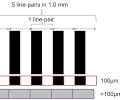
Visual resolution in line pairs per millimeter (
) measures an imaging system's ability to distinguish alternating black and white lines within
. It is a common metric for lenses, film, and night vision. Human vision can resolve up to 5
at adistance

1776816271484.png

Vision is a combination of multiple variables.

Given plenty of sunlight at a distance I may make out an object as a car, but no details. As I get closer I will make out wheels and bumblers.

At some distance I will make out details on a car. As daylight fades I can make out a car but no details.

I am looking at billboard. As daylight fades I can make out it is a billboard, but not read the words.
 
Back
Top Bottom