• Welcome to the Internet Infidels Discussion Board.

“Revolution in Thought: A new look at determinism and free will"

So what happens when the light that bounced off the object disperses due to the inverse square law?
Nothing happens. The light carries on through space until it encounters something.

Do you know what the inverse square law is?
Are you saying that we will still see the object because it's still traveling toward our eyes?
Sorry, but this is the crux of your problem; You are apparently incapable of being clear in what you say, and I assume are also incapable of thinking clearly.

Your question is incomprehensible, because the pronoun "it" could stand for more than one noun.

Let's try to make your question meaningful:
Are you saying that we will still see the object because the light is still traveling toward our eyes?
Clearly, no. We won't ever see any object until the light from it has reached our eyes. While it is still travelling towards our eyes, it's not doing anything except travel.
Are you saying that we will still see the object because the object is still traveling toward our eyes?
Clearly, also no. There is no suggestion that the object is moving at all. From context, it seems unlikely that this was the question you intended; But your woolly and imprecise use of language has resulted in its being the question you actually asked.

The only valuable point here is in the lesson you should take from it: In order to ever understand anything, first you must be precise and accurate in the way you think about it. And in order to convey your understanding to others, you must be precise and accurate in the way you talk about it, too.

Pedantry is an absolutely indispensible precursor to understanding. The reason physicists (and scientists generally) use mathematics rather than plain English, is that plain English is often vague and imprecise, and just won't do to convey accurate and meaningful information.

If you want to understand your own thoughts, you need to be precise and unequivocal when thinking.

And you need to grasp the simple truth that everything hangs together. If one part of your thinking relies on a given premise (P1), and another relies on a premise that contradicts it (NOT P1), then some or all of what you think must be wrong.

The foundations of reality are the same for all aspects of reality. Mass-Energy is conserved; Nothing with rest mass can travel at c; c is invariable for all observers; Anything with zero rest mass must travel at c in a vacuum; Angular Momentum is conserved; Entropy of closed systems always increases; No information can travel faster than c.

Disregarding any of these usually leads to provably false predictions about reality.

Demonstrating any of them to be false will get you a Nobel Prize.

Failing to consider them at all before making claims about how reality works will get you ridicule; And rightly so.

They are not unchallengable; Nobel prizes are not unattainable. But they have stood the test of wannabe Nobel laureates for a century, so casually assuming that they can be disregarded is the action of a fool.

You are going to need a lot more than woolly language and faith in some idiot's books, if you want to change the world. All the easy bits were done three hundred years ago, and even the hard bits have mostly been squared away since 1912.
 
The inverse square law should help you understand why the object's wavelength/frequency does not travel forever through space/time.
Once again, for those who have not been paying attention for the last 6,773 posts:

NOBODY THINKS OBJECTS EVEN HAVE A WAVELENGTH/FREQUENCY except you.

I don't need help to understand that a non-existent thing doesn't do stuff.
Okay, objects absorb and reflect light. It is this reflection that lands on our retina and allows us to see the object, but the reflection (or wavelength/frequency) does not travel through space/time ad infinitum. We see the object as long as the light that the object reflects has not dispersed beyond what the inverse square law allows. Gosh, this is hard. I hope my being here is not for naught. :HEADBUTT:

It’s completely for naught, just as it was everywhere else you have been.

I’ve been reading your latest exchanges with bilby and have been gobsmacked by how utterly stupid and meaningless your comments are. You simply know nothing. You cannot even remotely correctly characterize what science says about these matters.

Yet I am also perplexed why I am gobsmacked. You have been repeating this same drivel, word for word, since around 2000.

I guess I remain gobsmacked because I just cannot get over how someone could be so thoroughly and comprehensively wrong about quite literally everything.
 
Pg

There is inverse square for sound as well. There are universal principles that apply to different phu8scalpenomena.

Electrical impedance, resistance, capacitance and inductance have analogs in mechanical systems and heat transfer..


When you argue against light and reflation you also dispute acoustics and sound reflection.
 
The inverse square law should help you understand why the object's wavelength/frequency does not travel forever through space/time.
Once again, for those who have not been paying attention for the last 6,773 posts:

NOBODY THINKS OBJECTS EVEN HAVE A WAVELENGTH/FREQUENCY except you.

I don't need help to understand that a non-existent thing doesn't do stuff.
Okay, objects absorb and reflect light. It is this reflection that lands on our retina and allows us to see the object, but the reflection (or wavelength/frequency) does not travel through space/time ad infinitum. We see the object as long as the light that the object reflects has not dispersed beyond what the inverse square law allows. Gosh, this is hard. I hope my being here is not for naught. :HEADBUTT:
Unless it meets something photons go on definitely.

Take a golf ball far out into intergalactic space and speed it up. It goes on until it interacts with something..

Photons go on but energy density(photons/meter^2) go down.


There is a science thread on this one.


1776805551363.png
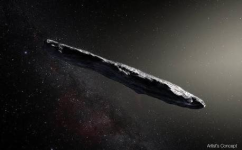
Yes, interstellar objects (ISOs)—objects originating from outside our solar system—have passed through it. Astronomers have officially detected three: 1I/‘Oumuamua (2017), 2I/Borisov (2019), and 3I/ATLAS (2025). These objects are considered "planetary shrapnel" ejected from other star systems, travelling through the galaxy before visiting our neighborhood.
 
So what happens when the light that bounced off the object disperses due to the inverse square law?
Nothing happens. The light carries on through space until it encounters something.

Do you know what the inverse square law is?
Are you saying that we will still see the object because it's still traveling toward our eyes?
Sorry, but this is the crux of your problem; You are apparently incapable of being clear in what you say, and I assume are also incapable of thinking clearly.

Your question is incomprehensible, because the pronoun "it" could stand for more than one noun.

Let's try to make your question meaningful:
Are you saying that we will still see the object because the light is still traveling toward our eyes?
Clearly, no. We won't ever see any object until the light from it has reached our eyes. While it is still travelling towards our eyes, it's not doing anything except travel.
Are you saying that we will still see the object because the object is still traveling toward our eyes?
Clearly, also no. There is no suggestion that the object is moving at all. From context, it seems unlikely that this was the question you intended; But your woolly and imprecise use of language has resulted in its being the question you actually asked.
I meant the reflection of the object.
The only valuable point here is in the lesson you should take from it: In order to ever understand anything, first you must be precise and accurate in the way you think about it. And in order to convey your understanding to others, you must be precise and accurate in the way you talk about it, too.
That's fair enough.
Pedantry is an absolutely indispensible precursor to understanding. The reason physicists (and scientists generally) use mathematics rather than plain English, is that plain English is often vague and imprecise, and just won't do to convey accurate and meaningful information.

If you want to understand your own thoughts, you need to be precise and unequivocal when thinking.
Even though the words he used were not considered precise enough, they can be understood. I understand your point. Let's leave it at that.
And you need to grasp the simple truth that everything hangs together. If one part of your thinking relies on a given premise (P1), and another relies on a premise that contradicts it (NOT P1), then some or all of what you think must be wrong.
Obviously, if two premises contradict each other, something is wrong, but nothing in his proof has contradicted itself.
The foundations of reality are the same for all aspects of reality. Mass-Energy is conserved; Nothing with rest mass can travel at c; c is invariable for all observers; Anything with zero rest mass must travel at c in a vacuum; Angular Momentum is conserved; Entropy of closed systems always increases; No information can travel faster than c.
I am not debating physics, which I have said many many times. I am debating delayed vision. If this is considered physics, then so be it.
Disregarding any of these usually leads to provably false predictions about reality.
Again, the speed of light is not being debated. The only thing being debated is how the brain and eyes work, and I am not conceding because you want me to.
Demonstrating any of them to be false will get you a Nobel Prize.
I don't want the Nobel prize. He didn't either. What I want is a world where there is no war or crime, and no disrespect.
Failing to consider them at all before making claims about how reality works will get you ridicule; And rightly so.
You are wrong here. He didn't have to understand all of physics and astronomy to know what he was talking about regarding how we become conditioned, which could not come about any other way. I don't think you understand why this is not a matter of opinion.
They are not unchallengable; Nobel prizes are not unattainable. But they have stood the test of wannabe Nobel laureates for a century, so casually assuming that they can be disregarded is the action of a fool.
Who is talking about a Nobel Prize? This is the last thing I'm thinking about. :unsure:
You are going to need a lot more than woolly language and faith in some idiot's books,
You'd better watch the way you address this man if you want to converse. If you don't, then keep it up.
if you want to change the world. All the easy bits were done three hundred years ago, and even the hard bits have mostly been squared away since 1912.
No bilby. You are sure he has nothing, so you say the things you say. Look at the world we live in, and you tell me if the easy bits have been done.
 
The inverse square law should help you understand why the object's wavelength/frequency does not travel forever through space/time.
Once again, for those who have not been paying attention for the last 6,773 posts:

NOBODY THINKS OBJECTS EVEN HAVE A WAVELENGTH/FREQUENCY except you.

I don't need help to understand that a non-existent thing doesn't do stuff.
Okay, objects absorb and reflect light. It is this reflection that lands on our retina and allows us to see the object, but the reflection (or wavelength/frequency) does not travel through space/time ad infinitum. We see the object as long as the light that the object reflects has not dispersed beyond what the inverse square law allows. Gosh, this is hard. I hope my being here is not for naught. :HEADBUTT:

It’s completely for naught, just as it was everywhere else you have been.
No Pood. Stop using the fact that I went to certain unmoderated, disgusting forums as if this somehow proves he was wrong. You are using the worst syllogistic reasoning I've ever witnessed.
I’ve been reading your latest exchanges with bilby and have been gobsmacked by how utterly stupid and meaningless your comments are. You simply know nothing. You cannot even remotely correctly characterize what science says about these matters.
For the thousandth time, he didn't have to use technical words to explain his account on vision, although now that I'm here on Lessans' behalf, I'm trying to work with bilby to get the author's points across more clearly. What I will not accept are ad homs and insults aimed at Lessans, which he does not deserve.
Yet I am also perplexed why I am gobsmacked. You have been repeating this same drivel, word for word, since around 2000.
Could it be that there is a kernel of truth in his words that you haven't been able to admit to yourself? :unsure:
I guess I remain gobsmacked because I just cannot get over how someone could be so thoroughly and comprehensively wrong about quite literally everything.
I needed that comic relief. Thank you! 😂
 
Last edited:
All I am doing is replacing wavelength/frequency with image. Using the word "image" doesn't change the meaning.
Yes, it does. Different words have different meanings. By using different words, you are changing the meaning.

The only time that would not be true is if the different words were synonyms - which is absolutely NOT the case here; Or if your sentence was never meaningful in the first place - which is quite probably the case here.

Are your contributions to this thread some kind of nonsense art project? If I want to read nonsense poetry, I usually prefer to read Lewis Carroll.

You remind me a lot of the Red Queen, actually.

Do you know what the inverse square law is?
We see the object as long as the light that the object reflects has not dispersed beyond what the inverse square law allows.
So, that would be a "no", then.
 
You are still thinking in terms of a gap between the object and the eye. That is because you have not fully grasped this account of vision. there is a measurable and bloody obvious gap between the object and the eye
FTFY.
Nooo, there isn't, not if you are seeing the object, NOT INTERPRETING THE LIGHT!!!
"Seeing" is a verb. A doing word. You say that I am doing something to a distant object, without anything crossing the gap between me and that object.

I say that's impossible. I also say that there's no explanation or evidence coming from you as to how it might be possible. I also say that I have an explanation (that entails light crossing the gap) which completely explains the situation as we observe it to be, without recourse to belief in the impossible, or in the unevidenced.

The object is over there. How am I seeing it, when I am over here?
 
You're playing with semantics
No, I am asking you to use words to carry meaning, rather than to obscure it, by the simple expedient of not abusing them to mean things that only you think that they mean.
Whatever! I do not think I am abusing words to mean things that only I think that they mean,
Well, you are, whether you think it or not.
but I'll use wavelength/frequency for now,
You have been since the beginning. Indeed, it is your abjectly incorrect use of those words, without the slightest effort to understand their meanings, to which I am objecting.
so you will see that I'm trying to work with you.
"I am going to keep doing it wrong so you will see me trying to do it right" is not the killer argument you seem to think.
 
You are still thinking in terms of a gap between the object and the eye. That is because you have not fully grasped this account of vision. there is a measurable and bloody obvious gap between the object and the eye
FTFY.
Nooo, there isn't, not if you are seeing the object, NOT DETECTING THE LIGHT!!!
There is a measurable and bloody obvious gap between object and eye whether you are seeing the object or not.
This is where you are mistaken, and why distance is not a factor as much as the object's size and brightness.
"as much as"? It's either a factor; Or it isn't.
 
I am not debating physics, which I have said many many times. I am debating delayed vision. If this is considered physics, then so be it.
It's not "considered physics"; It is physics.

You are, whether you know it or not, debating physics.

You failure to even understand what you are doing, much less understand how to do it, what it is, or what it is about, may go a long way towards explaining why your efforts are truly execrable.
 
What I want is a world where there is no war or crime, and no disrespect.
And you think that arguing from a position of abject ignorance about the physics of light and sight, until everyone who reads your nonsense thinks you a total clown, will somehow reduce the world's cumulative sum of disrespect? Or have any influence whatsoever on war or crime?

I hesitate to ask how you imagine that might work.
 
The only flaw is with the idea that the object's wavelength/frequency (IMAGE) travels to the brain rather than the brain looking through the eye to see the object itself. That's it.
Nope, that's not it. That's not anything, because literally nobody is saying that "the object's wavelength/frequency (IMAGE) travels to the brain", and the parenthetical "(IMAGE)" is a bizarre non-sequitur.
It is not a non-sequitur. It is central to this discussion. When I say the object's wavelength/frequency, I mean the light that has the potential to bring to the eye the image of the object. It might not be the words you use, but you should know what I mean by now.
Light reflects off objects, and travels to the brain.
Okay.
Light consists of a number of photons; Each has a frequency that, for visible light, we call colour (in the US, "color").
Got it.
As photons are constrained to travel at c, the frequency and wavelength of light become interchangeable; A photon of known frequency has a known wavelength and vice-versa.
So far so good.
Unless the object in question has a pure colour, or is illuminated by a pure colour source (such as a laser), the photons that reflect from it will have a wide range of individual frequencies, the average of which we call the colour(s) of the object's surface.
Right.
The pattern formed by these photons can be resolved into an image of the object. An image is a pattern on a plane through the straight-line path that light takes from object to that plane; By focussing the light through a lens, the pattern can be made to match the suface pattern of the object, and such a matching pattern is called an image of the object.
This is where we part ways. By focusing the light through the lens, we see the object through the pattern, which is called seeing in real time.
When a retina lies exactly on the focal plane of the lens, the pattern of light on the retinal cells matches the pattern of light on the surface of the object. If the retina is offset from the focal plane, then the image formed will be blurry, and will not match the pattern of the surface of the object - this can be corrected by interposing additional lenses to bring the focal plane more accurately onto the retina.
Correct.
This is what you are denying. (It is also how spectacles and contact lenses work).
Not at all. Corrective lenses work when the retina is offset from the focal plane, which can be corrected by bringing the focal plane more accurately on the retina. I'm not sure where you think this disproves efferent vision.
Now, please provide your similarly detailed description of what you are claiming.

How does "the brain [look] through the eye to see the object itself"? What role does light play in this, exactly?
I can only give you what he wrote because I can't say it any better, especially when I'm under a microscope. I am sure this won't satisfy you, but I'll keep trying.
-------------------------------------------------------------------

At a very early age, our brain not only records sound, taste, touch, and smell but also photographs the objects involved, which develops a negative of the relation, whereas a dog is incapable of this. When he sees the features of his master without any accompanying sound or smell, he cannot identify them because no photograph was taken. A dog identifies through his sense of sound and smell and what he sees in relation to these sense experiences, just as we identify most of the differences that exist through words and names. If the negative plate on which the relation is formed is temporarily disconnected — in man’s case the words and names and in a dog’s case the sounds and smells — both would have a case of amnesia. This gives conclusive evidence as to why an animal cannot identify too well with his eyes. As we have seen, if a vicious dog accustomed to attacking any person who should open the fence at night were to have two senses, hearing and smell, temporarily disconnected, and assuming that no relation was developed as to the way in which an individual walked, he would actually have amnesia, and even though he saw with his eyes his master come through the gate, he would have no way of recognizing him and would attack. But a baby, having already developed negatives of relations that act as a slide in a movie projector, can recognize at a very early age. The brain is a very complex piece of machinery that not only acts as a tape recorder through our ears and the other three senses and a camera through our eyes, but also, and this was never understood, as a movie projector. As sense experiences become related or recorded, they are projected, through the eyes, upon the screen of the objects held in relation and photographed by the brain. Consequently, since the eyes are the binoculars of the brain, all words that are placed in front of this telescope, words containing every conceivable kind of relation, are projected as slides onto the screen of the outside world, and if these words do not accurately symbolize, as with five senses, man will actually think he sees what has absolutely no existence; and if words correctly describe, then he will be made conscious of actual differences and relations that exist externally but have no meaning for those who do not know the words.


How do spectacles or contact lenses enable the brain to look through the eye to see the object clearly, when it could not be seen clearly without them, and without light taking time to travel the (short but non-zero) distance from retina to lens?
Light travels to the lens, but this doesn't explain how the brain and eyes see. They are two different things.
In order for the mechanism you claim to supplant the mechanism you are denying, it must explain all of the things that we observe, including such phenomena as correcting vision with spectacles; And it must explain them as well as, or better than, our existing explanation, while also explaining something else that the existing explanation does not.

If it can't, it would be unreasonable to adopt a new explanation or to give credence to a new mechanism.
Seeing in real time does not disrupt the way lenses work to correct vision. It has nothing to do with it. It has other important implications, but does not dispute any of the applications that use light in their technologies that are proven to work.

Memory function doesn't store information in the form of photographs. Light does not transmit information in the form of photographs.
How do you know what the brain is doing that proves that a photograph is not taken that forms a memory? Light is not what transmits information in the form of photographs. Light is a condition of sight, not a cause that transmits information (which claim you're entirely ignoring).

The brain does not take photographs. Memory is not stored in the form of photographs.
It's the connection between the word and the object. It's not an actual photograph DBT. You're not following him.
When we see something, we are not looking at photographs.
No, we're not. He never said we are.
Our experience is being generated by the brain using information detected/acquired by the eyes, with the information integrated with memory, which enables recognition .
Saying "information detected/acquired by the eyes" could be used in the afferent version of vision as well. In both accounts, whether we interpret an image or see the thing in real time doesn't change how our memories work or what the brain does with the information. Our experience is generated by the brain using what it sees, through the eyes, which is then integrated with memory, enabling recognition.
That is shown when memory function breaks down and the patient can no longer recognize what they see. There eyes are functioning, the information is transmitted to the visual cortex, but memory function fails to integrate the information in order to enable recognition.
This is true. It's called aphasia, I believe. Memory is essential. I don't know where you got the idea that vision is all that is needed without other parts of the brain to make sense of what is seen. Obviously, the memory portion of our brain that recognizes, categorizes, and integrates what is seen (whether in delayed or real time) is essential for a functioning human being to respond to his environment.

Nothing you say here, being full of errors and made up stuff that has no relationship to how the world works, supports real time/instant vision.
You keep saying it's full of errors, but you haven't shown where those errors are other than saying there is a gap between light and the eye. I think this claim is so repugnant to you, because you believe that vision cannot work the way Lessans described, that you're unwilling to listen to anything more.
Why that is so has been repeated countless times, only to be casually brushed aside without consideration.
I have not casually brushed anything aside, but I believe Lessans was right. What can I say to you (other than admitting he was wrong, which I will not do) that will keep you here before closing the door? :confused2:


Why cling to an idea that is obviously wrong? Why not come to terms with it being wrong and let it go?
 
No bilby. You are sure he has nothing, so you say the things you say.
Yes, and yes. Well done!
Look at the world we live in, and you tell me if the easy bits have been done.
Yes, they have. Quite a bit of the hard bits too.

Famine is rare. More people suffer the effects of too much food than suffer the effects of too little. Disease is so rare that people assume their children will live to become adults, and think that childhood illnesses are so trivial that vaccination is unimportant. Kings are beholden to elected bodies, and most are mere figureheads who no longer command their subjects to die in personal disputes.

The world is VASTLY better than it was four centuries ago. We can travel across the entire globe in a day, drinking cocktails and eating steak dinners, watching movies, or sleeping in a comfortable bed while we do so. We can buy fruits and vegetables of every kind, year round, at prices even peasants can afford. Spices are so cheap that "vanilla" has come to mean "ordinary".

The world is spectacularly and undeniably better now than at any time in the past, and this is almost entirely the consequence of people abandoning your preferred epistemology (of picking a book and believing it with all their heart), in favour of the scientific method.

The shitty parts of the world are those parts where belief and tribalism still hold sway.

The proof of the value of reason and science is so all pervading that you treat it as though it were a natural and expected part of reality upon which you can be a fat and happy parasite, while not even bothering to try to understand it at all.
 
Back
Top Bottom