• Welcome to the Internet Infidels Discussion Board.

"Line numbers" finding a number for any symbol

Note that in Genesis 1 it talks about the waters above vs the waters below - and both the sky and the waters below are bluish/cyan.
Yawn. So does Creatures of Light and Darkness (Zelazny).


“The Prince Who Was A Thousand walks beside the sea and under the sea. The only other intelligent inhabitant of the world within which he walks cannot be sure whether the Prince created it or discovered it. This is because one can never be sure whether wisdom produces or merely locates, and the Prince is wise.

He walks along the beach. His footsteps begin seven paces behind him. High above his head hangs the sea.

The sea hangs above his head because it has no choice in the matter. The world within which he walks is so constructed that if one were to approach it from any direction, it would appear to be a world completely lacking in land masses. If one were to descend far enough beneath that sea which surrounds it, however, one would emerge from the underside of the waters and enter into the planet’s atmosphere. Descending still farther, one would reach dry land. Traversing this land, one might come upon other bodies of water, waters bounded by land, beneath the sea that hangs in the sky.”

The big sea flows perhaps a thousand feet overhead. Bright fish fill its bottom, like mobile constellations. And down here on the land, everything glows.”
 
Last edited:
Math says there are curves that can be defined by bezier curves and that can't.

Bezier curves are curves defined by a set of numbers on points.

Some curves can't be rendered this way.

So there is an infinite family of shapes that can be defined by bezier curves and another infinite family of shapes that can't, and these are uncountably infinite. And there are other shapes still that are even weirder.

This would mean you would start needing signs and symbols to differentiate which parts of the symbol you use.

...So you would really need a whole set of equations with which to construct this stuff.

Just a single number line can't do it.
 
Math says there are curves that can be defined by bezier curves and that can't.

Bezier curves are curves defined by a set of numbers on points.

Some curves can't be rendered this way.

So there is an infinite family of shapes that can be defined by bezier curves and another infinite family of shapes that can't, and these are uncountably infinite. And there are other shapes still that are even weirder.

This would mean you would start needing signs and symbols to differentiate which parts of the symbol you use.

...So you would really need a whole set of equations with which to construct this stuff.

Just a single number line can't do it.
Now I'm talking about the set of shapes/symbols only going up to 5 lines like I've been showing. Do you have a problem with that? Do individual bezier curves never have a kink in them? Does the count of bezier curves match the number of lines I'm talking about?
 
Math says there are curves that can be defined by bezier curves and that can't.

Bezier curves are curves defined by a set of numbers on points.

Some curves can't be rendered this way.
Well I want to include all curves so therefore bezier curves aren't sufficient.
This would mean you would start needing signs and symbols to differentiate which parts of the symbol you use.
Each line could just be in a different colour - similar to subtle line boundaries in the dove:
christian-png.38281

...So you would really need a whole set of equations with which to construct this stuff.

Just a single number line can't do it.
I don't see a problem with what I've done in that image I just included... the line number is the minimum number of lines that can be used to draw it without any kinks.
 
Last edited:
Math says there are curves that can be defined by bezier curves and that can't.

Bezier curves are curves defined by a set of numbers on points.

Some curves can't be rendered this way.

So there is an infinite family of shapes that can be defined by bezier curves and another infinite family of shapes that can't, and these are uncountably infinite. And there are other shapes still that are even weirder.

This would mean you would start needing signs and symbols to differentiate which parts of the symbol you use.

...So you would really need a whole set of equations with which to construct this stuff.

Just a single number line can't do it.
Now I'm talking about the set of shapes/symbols only going up to 5 lines like I've been showing. Do you have a problem with that? Do individual bezier curves never have a kink in them? Does the count of bezier curves match the number of lines I'm talking about?
Some bezier curves have kinks. In fact straight lined geometric shapes are subclasses of bezier curves, and there are an uncountably infinite number of these just in terms of perimeters as a system of equations. You could consider them degenerate in a way, I think.
 
Some bezier curves have kinks. In fact straight lined geometric shapes are subclasses of bezier curves, and there are an uncountably infinite number of these just in terms of perimeters as a system of equations. You could consider them degenerate in a way, I think.
I consider a bezier curve with kinks to involve two or more straight/curved lines. So bezier curves aren't relevant to what I'm talking about. Also two or more lines that join with no kinks counts as one line. I'm trying to have an objective rather than subjective approach. I mean a person might claim a circle can involve two or more lines but that isn't true in the system like I explained earlier. Or they might say a triangle can involve one line - but it doesn't if you keep the rule about the kinks in mind.
 
Last edited:
Some bezier curves have kinks. In fact straight lined geometric shapes are subclasses of bezier curves, and there are an uncountably infinite number of these just in terms of perimeters as a system of equations. You could consider them degenerate in a way, I think.
I consider a bezier curve with kinks to involve two or more straight/curved lines. So bezier curves aren't relevant to what I'm talking about. Also two or more lines that join with no kinks counts as one line. I'm trying to have an objective rather than subjective approach. I mean a person might claim a circle can involve two or more lines but that isn't true in the system like I explained earlier. Or they might say a triangle can involve one line - but it doesn't if you keep the rule about the kinks in mind.
You don't know what a bezier curve is, do you?

(Full disclosure - nor do I, but I am not afraid to admit my ignorance on that score. Mathematics is very much not my field).
 
You don't know what a bezier curve is, do you?

(Full disclosure - nor do I, but I am not afraid to admit my ignorance on that score. Mathematics is very much not my field).
Well I used bezier curves in Inkscape to create a lot of the shapes/symbols that I included in this thread...
I know the basics but not every single thing about it. For the trinity symbol in post #8 I couldn't make the curves look exactly like how I wanted and I think that was due to issues in how bezier curves work.
post_c49508f5af61395934bb037fab149580.png

 
Some bezier curves have kinks. In fact straight lined geometric shapes are subclasses of bezier curves, and there are an uncountably infinite number of these just in terms of perimeters as a system of equations. You could consider them degenerate in a way, I think.
I consider a bezier curve with kinks to involve two or more straight/curved lines. So bezier curves aren't relevant to what I'm talking about. Also two or more lines that join with no kinks counts as one line.
They are absolutely relevant. All closed and non-closed curves created by straight segments up to the segment limit count.

As I said, there's uncountably infinitely many of those, with a discrete value at each vertex.

You could limit it by making a grid and then having pairwise groups for segment ends, up to the maximum, and there would be a (large) number of permutations, with some including dots. This would also make some shapes impossible
 
They are absolutely relevant. All closed and non-closed curves created by straight segments up to the segment limit count.

As I said, there's uncountably infinitely many of those, with a discrete value at each vertex.
Are you saying that a circle can involve two or more lines and/or bezier curves? BTW what about the case of a cross? Those two lines aren't connected. How is a system saying a circle is made up of an arbitrary number of bezier curves superior to me saying there is objectively only one line? (within the system)
You could limit it by making a grid and then having pairwise groups for segment ends, up to the maximum, and there would be a (large) number of permutations, with some including dots. This would also make some shapes impossible
As far as a maximum goes, I'm mainly only focusing on the first five (up to the pentagram). Then there is the Star of David (6) but other symbols with a lot of lines aren't that interesting.

I think a 10 year old could understand what I'm talking about. I don't see how talking about bezier curves would improve things at all.
 
Last edited:
They are absolutely relevant. All closed and non-closed curves created by straight segments up to the segment limit count.

As I said, there's uncountably infinitely many of those, with a discrete value at each vertex.
Are you saying that a circle can involve two or more lines and/or bezier curves? BTW what about the case of a cross? Those two lines aren't connected. How is a system saying a circle is made up of an arbitrary number of bezier curves superior to me saying there is objectively only one line? (within the system)
You could limit it by making a grid and then having pairwise groups for segment ends, up to the maximum, and there would be a (large) number of permutations, with some including dots. This would also make some shapes impossible
As far as a maximum goes, I'm mainly only focusing on the first five (up to the pentagram). Then there is the Star of David (6) but other symbols with a lot of lines aren't that interesting.

I think a 10 year old could understand what I'm talking about. I don't see how talking about bezier curves would improve things at all.
I'm not saying one system is superior to another. I'm saying that there's no way to make what you want "countable" in a real way, by showing a subset of everything you wish to count is uncountably infinite.
 
I'm not saying one system is superior to another. I'm saying that there's no way to make what you want "countable" in a real way, by showing a subset of everything you wish to count is uncountably infinite.
This is about historical graphical symbols like those drawn by hand - e.g. post #12 shows cave paintings. There are very complex hand-drawn sigils in post #33 but this system could count the lines - though I think those sigils are very arbitrary and I'm talking about more objective meaning. Though the changes in line thickness in those sigils could create issues in counting the number of lines. Even if the lines in the sigils were counted it is meaningless unlike the 2 line red blood "energy", etc.
What things are you saying are "uncountably infinite"? Circles? Things infinitely more complex than those sigils?
This is about actual examples of esoteric geometry and symbols not theoretical infinite drawings.
 
Last edited:
This is a thing on eBay that kind of fits the numbers and colours -

"Positive" - 3 lines (vertical, horizontal, outer circle) - green
"Neutral" - 5 lines (square, outer circle) - grey (dark white)
"Negative - 2 lines (horizontal, outer circle) - red
ebay.PNG
 
Also I'm talking about the first 5 line number shapes/symbols. That is related to base 6 (senary) which only involves symbols for 0, 1, 2, 3, 4, 5.

Note that in senary you can count from 0 to 35 with two hands:
Each regular human hand may be said to have six unambiguous positions; a fist, one finger extended, two, three, four, and then all five fingers extended.

If the right hand is used to represent a unit (0 to 5), and the left to represent the multiples of 6, then it becomes possible for one person to represent the values from zero to 55senary (35decimal) with their fingers, rather than the usual ten obtained in standard finger counting.
I think base 10 finger counting is the only reason that humans have used base 10.
Related to base 6 or senary is the hexagon.
This talks about the hexagon being the optimal shape or structure including honeycomb, bees eyes, graphene, snowflakes, etc.

Besides the hexagon, triangles and squares also tile tightly and are simple - and triangle grids can be turned into hexagon grids.

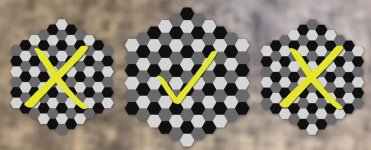
This is a hex chess board:

hex-chess.jpg

It starts with white at the bottom, then gray, then black, etc.

So this is another link between 3 and 6.

Related to this are ternary computers: (they are made up of 3 states)

While binary computers basically have just 0 and 1, ternary computers can have +, 0, and -. (positive, neutral, negative aka "balanced ternary") - which is related to our emotions (seek, neutral, avoid). Also binary can involve true and false while ternary can have indeterminate ("?").
 
Last edited:
I was told that a 5 pointed star is a feminine star while the 6 pointed star is masculine.
You were lied to. Odd numbers are male, even numbers female. I thought everyone knew that.
Thanks for pointing this out... it makes a lot of sense and seems objective rather than subjective.

I asked Copilot about this...

🜂 1. The oldest rule: Odd = masculine, Even = feminine​

This pattern appears in:
  • Pythagorean numerology
  • Greek philosophy
  • Hebrew mysticism
  • Islamic geometry
  • Chinese cosmology (Yang = odd, Yin = even)
  • Medieval Christian symbolism
  • Renaissance art theory
It’s one of the most stable symbolic assignments in human history.

Odd numbers → masculine

  • active
  • dynamic
  • directional
  • penetrating
  • unstable / energetic

Even numbers → feminine

  • receptive
  • balanced
  • containing
  • stable
  • grounding
This is symbolic, not biological.

🔺 2. Apply that rule to geometric shapes (traditional symbolism)​
Across sacred geometry and classical design:

Masculine-coded shapes (odd-numbered features)

  • Triangle (3 sides)
  • Pentagon (5 sides)
  • Heptagon (7 sides)
  • Circle is often treated as masculine in numerology because it is “1 shape” (unity, singularity)

Feminine-coded shapes (even-numbered features)

  • Square (4 sides)
  • Hexagon (6 sides)
  • Octagon (8 sides)
  • Cross (4 endpoints) is traditionally feminine-coded in medieval geometry because it represents the four directions, the earth, and grounding.
This is why architecture uses:
  • triangles for force, ascent, aggression
  • squares for stability, home, containment
So it talks about circles and crosses.

1 - Circle - male
2 - Cross - female
3 - Triangle - male
4 - Square - female
5 - Pentagram - male
6 - David's Star - female
 
Last edited:
Though with the circle and cross (hugs and kisses, noughts and crosses) I think the circle seems more feminine and grounded and the cross seems more masculine and aggressive...
 
So the hex board has 3 colors (when no adjacent cells can have the same color)

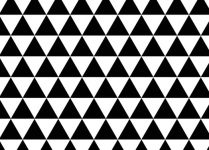
But square and triangle grids only need 2 colors: (black/white or all/nothing)

triangle-checkerboard.png

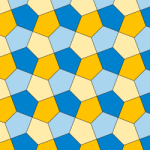
The pentagonal grid involes 4 colors... (apparently - I couldn't really verify it in my mind)
Equilateral_Cairo_tiling.svg.png

Though it involves irregular pentagons.

4 colors for the pentagonal grid is the most number of colors needed for any other possible grid...
 
Last edited:
Back
Top Bottom