• Welcome to the Internet Infidels Discussion Board.

Artemis launch

AI Overview
The Artemis II Orion capsule aligns itself for reentry using a combination of aerodynamic design, active guidance through small thrusters, and a controlled "skip entry" technique to manage heating and ensure a safe landing angle.
Key Aspects of Reentry Alignment:

Separation and Orientation: Prior to entering the atmosphere, the Crew Module separates from the Service Module, exposing the heat shield. Small reaction control thrusters are used to orient the capsule, placing the heat shield in the forward position.
Modified Skip Entry: Artemis II employs a "skip" maneuver, where the capsule dips into the upper atmosphere, rises slightly to radiate heat and reduce speed, then dives back down for a final, cooler landing. This prevents the intense heating associated with a single-pass, steep entry.
Lift Vector Steering: By rotating (rolling) the entire capsule, on-board computers adjust the direction of the "lift" generated by its shape.
To skip up: Lift is directed away from Earth.
To stay down: The capsule rolls 180 degrees to direct the lift toward the Earth, ensuring it stays within the atmosphere.
High-Precision Guidance: The reentry requires immense precision, as the flight path angle has a margin of less than one degree, necessitating precise, automated control to handle the 25,000 mph entry speed.

This process relies on atmospheric drag to slow the capsule down gradually to a speed where the parachutes can deploy safely.

The video of the tiny capsule in free fall was something.
 
So glad this all went to plan. With all the SpaceX failures, and Boeing's issues, you start to expect failures to be a default. I think 2028 is absurdly too soon for a landing on the Moon.
 
I have little use for the mentality of "doing stuff is hard/expensive/unpopular, so let's just do nothing". A nation that makes apathy its core philosophy quickly becomes overshadowed by those which encourage research, exploration, social wellbeing, and the arts.
I agree. I think we should explore the Moon and Mars.

I don't, however, think that we should kid ourselves that doing so will turn a profit. Or directly help with any of our other problems.

There will probably be some indirect benefits, none of which are likely foreseeable.

But building a Death Star (or a moonbase, or whatever) is probably a good idea.
Look at what happened with Apollo.

Did the Apollo mission produce any direct economic benefit? Little if any. Did gathering up a bunch of scientists and engineers and giving them an exceedingly hard problem to solve produce any indirect economic benefit? Virtually certainly far more than Apollo cost. I'm wearing a descendant of Apollo tech right now--a fitness tracker.
 
I am familiar with the space elevator concept but not sufficiently knowledgeable to comment about in detail.

That said, it seems it would be very vulnerable to attack or natural disaster.
The ground position inherently must be on the equator. You build your anchor platform at sea, it has anchor chains going to weights on the sea floor--not directly tied. Use an area of flat seafloor. There's virtually no natural disaster that can harm it. (No hurricanes at the equator.)

There is, however, a tremendous and probably insolvable issue of it being struck by space debris.
 
I am familiar with the space elevator concept but not sufficiently knowledgeable to comment about in detail.

That said, it seems it would be very vulnerable to attack or natural disaster.
The ground position inherently must be on the equator. You build your anchor platform at sea, it has anchor chains going to weights on the sea floor--not directly tied. Use an area of flat seafloor. There's virtually no natural disaster that can harm it. (No hurricanes at the equator.)

There is, however, a tremendous and probably insolvable issue of it being struck by space debris.

What about deliberate attack?
 
I wonder sometimes if an active propulsion space elevator would be possible, or a boyancy supported space elevator would be possible, or some admixture.

Like, we can't just have a cable because the top of the cable can't support the bottom and the bottom of the cable can't support the top, but if the cable itself carries energy (and many of the carbon structures proposed for the material base are good conductors), the cable itself can be powered by stations at both ends and supported with electric motors and rotors, and even the gravitational shear forces themselves could be used for part of the energy needed to hold it up.

To me, the bigger issue comes in that there's going to be a fuck ton of atmosphere being moved to support so much material, and that in and of itself creates issues, as the downdraft may very well make the environment around the cable "problematic".

ETA: or would the electron pressure in the carbon structure itself cause mechanical instabilities?
Buoyancy on what? The vast majority of the elevator is out of the atmosphere.

And, remember, space is about fast far more than it is about high. An elevator that could lift something to the top of the atmosphere would be of almost no value.
 
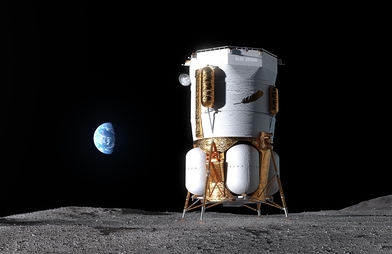
Next hen lunar lander. Buck Rogers here we come?

Apparently Blue Origin has been selected, bottom picture.

View attachment 53996

View attachment 53997


Why are they streamlined, and who designs pressurised craft with big and/or square windows?
The Apollo lander traveled inside the upper stage, it never saw atmosphere and didn't need to be streamlined. These appear to be flying from Earth.

And there isn't any reason against square windows on something like this. Square windows are a horrible idea if you are going through many, many cycles, but these aren't.
 
One thing I've never understood about a space elevator was the foundation. I'll temporarily allow people to think that nanotubes are strong enough to allow a cantilever force of gargantuan proportions as well thermal expansions / contractions, weather, wayward ducks, but how does that force get managed by the earth, where the foundations are?
Same way trees do it - deep roots, lots of buttressing. Spread the load over a relatively large volume of crust.

View attachment 53999
You can make the foundation/anchor using conventional earthbound construction techniques and materials. That's the one part that needn't be launched into orbit.
But can you? I mean sure, trees can get pretty tall, but not a mile tall. When talking about the sheer scale, you are engaging a lot of fractured rock.

Forget about the bearing mass.
You're thinking compression.

A space elevator must be in tension, it exerts no weight on the ground. Your foundation must be anchored to the cable strongly enough to keep the cable from lifting it but it doesn't need to be a monstrosity.
 
Back
Top Bottom