• Welcome to the Internet Infidels Discussion Board.

“Revolution in Thought: A new look at determinism and free will"

How can I do justice to this book with a quick summary?

Yet that is exactly what you ask of us. To tell you what the books means.
You're wrong. I didn't ask anyone what the book means. I asked them if they read his explanation as to why man's will is not free, for starters. They need to understand that this explanation is not an opinion. How can I get past page 50 of a 600-page book if they can't even answer the first question?
A formal argument with premises and a conclusion is not a “quick summary.” You can do this with anything, including complicated concepts like relativity and QM. That you cannot do this for your father’s own book speaks volumes, namely that the book is vapid.
Wrong again. Your entire criterion for what constitutes truth is faulty. You want me to give a simple summary so you can throw it out. I gave a summary as to what this book is about, not a breakdown of the principles, which would never do it justice because it's too involved.

Summary: Many theories as to how world peace could be achieved have been proposed, yet war has once again taken its deadly toll in the 21st century. The dream of peace has remained an unattainable goal — until now. The following pages reveal a scientific discovery regarding a psychological law of man’s nature never before understood. This finding was hidden so successfully behind layers of dogma and misunderstanding that no one knew a deeper truth existed. Once this natural law becomes a permanent condition of the environment, it will allow mankind, for the very first time, to veer in a different direction — preventing the never-ending cycle of hurt and retaliation in human relations. Although this discovery originated from philosophical thought, it is factual, not theoretical, in nature.
 
How can I do justice to this book with a quick summary?

Yet that is exactly what you ask of us. To tell you what the books means.
You're wrong. I didn't ask anyone what the book means. I asked them if they read his explanation as to why man's will is not free, for starters. They need to understand that this explanation is not an opinion. How can I get past page 50 of a 600-page book if they can't even answer the first question?
A formal argument with premises and a conclusion is not a “quick summary.” You can do this with anything, including complicated concepts like relativity and QM. That you cannot do this for your father’s own book speaks volumes, namely that the book is vapid.
Wrong again. Your entire criterion for what constitutes truth is faulty. You want this simple summary so you can easily dismiss it. I gave a summary as to what this book is about. That's enough to either create an interest or not.

Summary: Many theories as to how world peace could be achieved have been proposed, yet war has once again taken its deadly toll in the 21st century. The dream of peace has remained an unattainable goal — until now. The following pages reveal a scientific discovery regarding a psychological law of man’s nature never before understood. This finding was hidden so successfully behind layers of dogma and misunderstanding that no one knew a deeper truth existed. Once this natural law becomes a permanent condition of the environment, it will allow mankind, for the very first time, to veer in a different direction — preventing the never-ending cycle of hurt and retaliation in human relations. Although this discovery originated from philosophical thought, it is factual, not theoretical, in nature.

No, that is not an argument. Please present a set of premises and a conclusion.

And no, I do not want a “simple summary so I can easily dismiss it,” I want a formal argument that we all then can rationally consider, You can’t provide that, by your own admission, so it follows that you have got nothing.
 
How can I do justice to this book with a quick summary?

Yet that is exactly what you ask of us. To tell you what the books means.
You're wrong. I didn't ask anyone what the book means. I asked them if they read his explanation as to why man's will is not free, for starters. They need to understand that this explanation is not an opinion. How can I get past page 50 of a 600-page book if they can't even answer the first question?
A formal argument with premises and a conclusion is not a “quick summary.” You can do this with anything, including complicated concepts like relativity and QM. That you cannot do this for your father’s own book speaks volumes, namely that the book is vapid.
Wrong again. Your entire criterion for what constitutes truth is faulty. You want me to give a simple summary so you can throw it out. I gave a summary as to what this book is about, not a breakdown of the principles, which would never do it justice because it's too involved.

Summary: Many theories as to how world peace could be achieved have been proposed, yet war has once again taken its deadly toll in the 21st century. The dream of peace has remained an unattainable goal — until now. The following pages reveal a scientific discovery regarding a psychological law of man’s nature never before understood. This finding was hidden so successfully behind layers of dogma and misunderstanding that no one knew a deeper truth existed. Once this natural law becomes a permanent condition of the environment, it will allow mankind, for the very first time, to veer in a different direction — preventing the never-ending cycle of hurt and retaliation in human relations. Although this discovery originated from philosophical thought, it is factual, not theoretical, in nature.
Ok, lay it on me, what is the deeper truth and here to fore unknown natural law?

Should be a simple question for you.

Revelation of hidden knowledge is a very old technique Dramatic effect.

'Learn the secrets of the ancients'.


Have you ever felt a hunger for something you can’t even put words to?

What if you are actually on a journey—a quest—that has spanned the ages, continents, lifetimes? It has survived victories, tragedies, wealth and poverty, unimaginable gains and losses. Death and rebirth, time and again.

Lessan's book i a revelatory crude form, of old styes and techniques.
 
Last edited:

Oh look, now we are dung!

The book is dung,
That's not what I meant, and you know it. I just meant that separating the chaff from the wheat when a genuine discovery is amidst so many false claims is hard to distinguish.
That quote is not mine.
 
Special relativity in a nutshell:

P1: the laws of physics are the same for all inertial observers (per Galileo)
P2: the speed of light is invariant as measured by all observers regardless of their frame
C: Time, space, and simultaneity are all relative.

See how simple that was?

Note that the above could not be true if we saw in real time.

Now you do the same for your book.

Can’t, can you?
No
 
To reiterate:

I am not interested in dismissing your author’s claims about determinism and free will out of hand. I am interested in exploring them.

But I am also not interested in your author’s self-congratulatory blather (“Oh, look! There’s a rabbi!”) and his imaginary dialogues with non-existent interlocutors.

I am interested in a formal philosophical argument.

To reiterate:

This means laying out a set of premises followed by a conclusion.

Step one: we test to see if the conclusion logically follows from the premises. If it does, the argument is valid.

Step two: we then examine whether the premises are true. If they are, the argument is sound.

Step three: we then explore whether there are any hidden (enthymematic) premises which themselves may be false and therefore undermine the soundness of the argument.

You can do this for the most complicated of subjects.

Again, argument for special relativity:

P1: The laws of physics are the same in all inertial frames (per Galileo).

P2: Light speed is invariant for all observers regardless of frame.

C: Time dilation, length contraction and relative simultaneity automatically fall out of P1 and P2.

See how simple that was? Two premises and a conclusion, and the argument is both valid and sound without any enthymematic premises.

I will also note again that the above argument, which is empirically established, definitively rules out real-time seeing.

But now I am only interested in the argument for determinism and free will. Real-time seeing is garbage that needs no further consideration.

Please present an argument the manner I have described above, and if you cannot, then you have nothing.

I tried to help you with this but you rejected my help. Now you’re on your own. Let’s see if you are up to the task.

I bet not.

Prove me wrong.
 
Special relativity in a nutshell:

P1: the laws of physics are the same for all inertial observers (per Galileo)
P2: the speed of light is invariant as measured by all observers regardless of their frame
C: Time, space, and simultaneity are all relative.

See how simple that was?

Note that the above could not be true if we saw in real time.

Now you do the same for your book.

Can’t, can you?
No

Ah, just saw this!

Thank you for your admission that you got nuthin’.
 
I have asked @peacegirl to do this.

To post a concise summary consisting of premises and a conclusion about her author’s argument to determinism and free will.

I have not asked to her to post such an argument about light and sight because her author’s claims in this respect are obvious garbage that cannot be sustained by any argument.

I tried to help peacegirl elucidate the author’s claims about determinism and free will in a formal manner. She rejected my help.

Can she do it herself?

No, she cannot.

Let’s see if she can prove me wrong.
This has nothing to do with proving YOU wrong. It has everything to do with proving him RIGHT.
 
I feel very sad about the news of Nancy Guthrie's kidnapping. The reason this is so disturbing to me is that the motivation to do this crime could never occur in the new world. :cry:
 
Suggestions?

If Lessans had presented his ideas as a fictional story of a person and people enacting his philosophy we might be reading it today.

Scifi and other writers have presented their vision of society as fiction and garnered an audience.

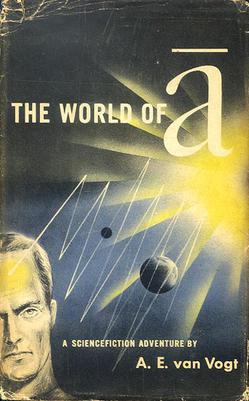
The Null-A series by A.E. van Vogt is a classic Golden Age science fiction trilogy focusing on non-Aristotelian logic, General Semantics, and superhuman abilities. Centered on protagonist Gilbert Gosseyn, the books explore themes of identity, evolution, and interstellar conspiracy.


Gilbert Gosseyn (pronounced go-sane), a man living in an apparent utopia where those with superior understanding and mental control rule the rest of humanity, wants to be tested by the giant Machine that determines such superiority. However, he finds that his memories are false. In his search for his real identity, he discovers that he has extra bodies that are activated when he dies (so that, in a sense, he cannot be killed), that a galactic society of humans exists outside the Solar System, a large interstellar empire wishes to conquer both the Earth and Venus (inhabited by masters of non-Aristotelian logic), and he has extra brain matter that, when properly trained, can allow him to move matter with his mind.

People may not realize how controversial the original Star Trek series was in the 60s. They framed social issues in scifi getting past the censors. And of course Twilight Zone, studies in humn nature.

Woulda Coulda Shoulda

The book is not fixable. It is pseudoscience.

You yourself can not speak to it, you dodge by saying it is too complex for words.
I am not interested in your accusations. You never answered fair questions to determine if you had any idea of what you understood. And you couldn't even answer any of them. Yet, you think you can attack this author with some kind of authority? You're out the door, Steve. I don't want to talk to you anymore. It's a waste.
 
How can I do justice to this book with a quick summary?

Yet that is exactly what you ask of us. To tell you what the books means.
You're wrong. I didn't ask anyone what the book means. I asked them if they read his explanation as to why man's will is not free, for starters. They need to understand that this explanation is not an opinion. How can I get past page 50 of a 600-page book if they can't even answer the first question?
A formal argument with premises and a conclusion is not a “quick summary.” You can do this with anything, including complicated concepts like relativity and QM. That you cannot do this for your father’s own book speaks volumes, namely that the book is vapid.
Wrong again. Your entire criterion for what constitutes truth is faulty. You want this simple summary so you can easily dismiss it. I gave a summary as to what this book is about. That's enough to either create an interest or not.

Summary: Many theories as to how world peace could be achieved have been proposed, yet war has once again taken its deadly toll in the 21st century. The dream of peace has remained an unattainable goal — until now. The following pages reveal a scientific discovery regarding a psychological law of man’s nature never before understood. This finding was hidden so successfully behind layers of dogma and misunderstanding that no one knew a deeper truth existed. Once this natural law becomes a permanent condition of the environment, it will allow mankind, for the very first time, to veer in a different direction — preventing the never-ending cycle of hurt and retaliation in human relations. Although this discovery originated from philosophical thought, it is factual, not theoretical, in nature.

No, that is not an argument. Please present a set of premises and a conclusion.

And no, I do not want a “simple summary so I can easily dismiss it,” I want a formal argument that we all then can rationally consider, You can’t provide that, by your own admission, so it follows that you have got nothing.
I don't care one whit what you want Pood. If you think this is bullshit, go somewhere else that will give you more bang for your buck! (y)
 
Observation not accusation. Many old and new traditions claim secret knowledge that will transformer individuals and the world.

You probably don't remember The Divine Light Mission. There was controversy. It was run by an Indian family and there was money involved. I knew a woman who said it transformed her life.


Before getting on the science and technology track I spent the first half of the 70s going thorough and reading diverse traditions. Lessan's book to me is a recognizable form.

I am not an expert in philosophy or mythology, but I did go through a diverse set of things. In the day that was certainly not unique.

Please, tells us the previously unknown great secret of human nature.

You are prolifically posting beaucoup words, but not answering the most fundamental question of the book.

Find your own peace first.

If you want world peace sit quietly and chant Namu Myōhō Renge Kyō.


Last edited:
The problem is that there are no physical means or mechanisms by which real time/ instant vision could work. It would have to be magic vision.
Incorrect. There is no gap if you see the object in real time, because it meets the requirements of size and luminosity. You keep assuming that, although light travels, it is bringing the image of the object to our eyes because the object reflected that lightwave. If the light does not bring the image to us through space/time, then how do we see without it violating physics? Efferent vision. You keep going back to the idea that when light strikes an object it takes on the object’s chacteristics, but that is not what is happening if Lessans is right. Light reveals. It is a necessary condition of sight, but it does not bring anything to us.

There is always a gap between light emission or reflection and information acquisition by the eyes, processing by the brain and conscious representation in the form of sight: we see the object.

That is basically how it works. No real time/ instant vision, just a physical process.
Nooo. You are missing the entire claim. Light travels, but the eyes and brain work differently than previously thought. You have to give this author a break, or you will just keep repeating the same old mantra that there is no way for us to see without light traveling to us with the image (sorry bilby, but this is the only way I can explain it). You will never get it if you keep thinking in these terms, not because he was wrong, but because you refuse to entertain the idea that there is no violation of physics.

Light in fact has speed and travel time. Light is in fact radiated by the sun, stars, etc, and reflected by the moon and other dark objects, the objects all around us during daylight hours are illuminated by the sun, and the moon and stars by night. We see these things because they either radiate or reflect light.

Without light we cannot see.
Right. Who is saying otherwise?
Go into a dark room and you see nothing, flip the light switch and there it all is, the room is illuminated.
Agreed.
It's as simple as that. The eyes acquire light, the brain generates vision. The eyes don't see, that is the function of the brain.
The brain focuses the eyes to see the real world. The brain doesn't generate vision.
Who is disputing this? The brain is involved, but it does not explain how this occurs. It's all theoretical, not fact!

You are disputing it with the claim of instant vision/seeing. Claiming that things like stars are seen instantly without the time lag between light emission and acquisition by the eyes and brain.

By making the claim, you are trying to bypass the fundamental principles of physics.
How many times have I said this version of sight does NOT violate physics? The reason we don't see stars without a time lag is the same reason we don't see the moon without a time lag. Distance is not as much a factor as size and luminosity. If a star exists but can't be seen because it is too far away, a telescope won't help. Any celestial body has to be visible, however faint, for a telescope to collect the light and magnify it. The ACTUAL star has to be visible, not just light that was emitted light-years earlier, which present-day thinking believes is all that is necessary. To repeat: The star has to be within the field of view of the telescope for it to collect the emitted light. It cannot magnify something that isn't there. IOW, if a star is too far away, and therefore too dim for it to be seen, a telescope won't be able to give us any new information.

Stars radiate light.
True.
That's how we are able to see them.
True.
Our eyes detect light from the stars
Our eyes see stars, not detect light.
and our brain generates mental imagery of them in conscious form. Stars are luminous because they emit light.
We see stars because they are there to be seen when enough light is present, according to this account.
 
Special relativity in a nutshell:

P1: the laws of physics are the same for all inertial observers (per Galileo)
P2: the speed of light is invariant as measured by all observers regardless of their frame
C: Time, space, and simultaneity are all relative.

See how simple that was?

Note that the above could not be true if we saw in real time.

Now you do the same for your book.

Can’t, can you?
Time indicates change. It is not a dimension.
 
If this is what you have concluded from my efforts to explain that you need to understand the principles in this book before coming to a premature conclusion, I HAVE FAILED.
Again.

The common factor in each of your failures is you. Perhaps it's time to consider changing yourself and your ideas, given the repeated abject failures of your plan to change everyone else and their ideas?
Bilby, 1000 dislikes of something unread and not understood means nothing compared to the 1 like of something read and understood. Get the gist?
 
Light travels. Light strikes an object, and it obeys the law of reflection.
Earlier you said light does not bounce off an object
Well, obviously it does both. It bounces off and does not bounce off, depending on what you are trying to prove at the time.
What? :oops: He did not say light bounces off and doesn't bounce off. Light is always traveling. The only thing that he disputes is that it does not take the object's wavelength with it. When we look at the object, in efferent vision, the light there, which allows us to see the object in real time. Here is that excerpt again. Read it or don't read it.

Decline and Fall of All Evil

p. 115 They reasoned that since it takes longer for the sound from an airplane to reach us when 15,000 feet away than when 5000; and since it takes longer for light to reach us the farther it is away when starting its journey, light and sound must function alike in other respects, which is false, although it is true that the farther away we are from the source of sound, the fainter it becomes, as light becomes dimmer when its source is farther away. If the sound from a plane, even though we can’t see it on a clear day, tells us it is in the sky, why can’t we see the plane if an image is being reflected towards the eye on the waves of light? The answer is very simple. An image is not being reflected. We cannot see the plane simply because the distance reduced its size to where it was impossible to see it with the naked eye, but we could see it with a telescope. We can’t see bacteria with the naked eye, either, but we can through a microscope. The actual reason we are able to see the moon is because there is enough light present, and it is large enough to be seen.

The explanation as to why the sun looks to be the size of the moon, although much larger, is because it is much much farther away, which is the reason it would look like a star to someone living on a planet at the distance of Rigel. This proves conclusively that the distance between someone looking and the object seen has no relation to time because the images are not traveling toward the optic nerve on waves of light; therefore, it takes no time to see the moon, the sun, and the distant stars. To paraphrase this another way, if you could sit upon the star Rigel with a telescope powerful enough to see me writing this very moment, you would see me at the exact same time that a person sitting right next to me would, which brings us to another very interesting point. If I couldn’t see you standing right next to me because we were living in total darkness since the sun had not yet been turned on, but God was scheduled to flip the switch at 12 noon, we would be able to see the sun instantly — at that very moment — although we would not be able to see each other for 8 minutes afterwards. The sun at 12 noon would look exactly like a large star, the only difference being that in 8 minutes we would have light with which to see each other, but the stars are so far away that their light diminishes before it gets to us.

Upon hearing this explanation, someone asked, “If we don’t need light around us to see the stars, would we need light around us to see the sun turned on at 12 noon? Once the light is here, it remains here because the photons of light emitted by the constant energy of the sun surround us. When the Earth rotates on its axis so that the section on which we live is in darkness, this only means the photons of light are on the other side. When our rotation allows the sun to smile on us again, this does not mean that it takes another eight minutes for this light to reach us, because these photons are already present. And if the sun were to explode while we were looking at it, we would see it the instant it happened, not 8 minutes later. We are able to see the moon, the sun, the distant stars, etc., not because one is 3 seconds away, the other 8 minutes away, and the last many light-years away, but simply because these objects are large enough to be seen at their great distance when enough light is present. This fallacy has come into existence because the eyes were considered a sense organ, like the ears. Since it takes less time for the sound from an airplane to reach our ears when it is a thousand feet away than when it is five thousand, it was assumed that the same thing occurred with the object sending a picture of itself on the waves of light. If it were possible to transmit a television picture from the Earth to a planet as far away as the star Rigel, it is true that the people living there would be seeing the ships of Columbus coming into America for the first time because the picture would be in the process of being transmitted through space at a certain rate of speed. But objects do not send out pictures that travel through space and impinge on the optic nerve. We see objects directly by looking at them, and it takes the same length of time to see an airplane, the moon, the sun, or distant stars.

To sum this up, just as we have often observed that a marching band is out of step with the beat when seen from a distance because the sound reaches our ears after a step has been taken, so likewise, if we could see someone talking on the moon via a telescope and hear his voice on the radio, we would see his lips move instantly but not hear the corresponding sound for approximately 3 seconds later due to the fact that the sound of his voice is traveling 186,000 miles a second, but our gaze is not, nor is it an electric image of his lips impinging on our optic nerve after traversing this distance. Because Aristotle assumed the eyes functioned like the other four and the scientific community assumed he was right, it made all their reasoning fit what appeared to be undeniable. According to their thinking, how else was it possible for knowledge to reach us through our eyes when they were compelled to believe that man had five senses? Were they given any choice?


And before you say "that's a contradiction", just think - do you really want people to continue to suffer, just so that you can point out contradictions?

The TruthTM doesn't care about mere contradictions.
There are no contradictions, bilby.
 
Foolish is one way to say it.

Ignorant, narrow minded, dogmatic.

You do adapt what you see posed and integrate it in to your narrative. That would IMO idicte intelligence.

When photons were mentioned to explain how the retina works you added photons to your posts. I brought up Faraday on this thread and you referenced him in another.

I see what you are dong and hear the wheels spinning in your head because for most of my adult life I was immersed in company politics. It was inescapable You are not in any way new to me.

From my perspective you have a marketing messaging problem. In a sense you are trying to sell a product.

'My product is great and a revolutionary new development. It will grow hair on your head and increase make virility Trust me I know it is true, my wife loves the results. Try it, for only $29.95 a bottle'

A typical TV supplement commercial narrative. in some ways similar form to your pitch for your ideas.

Nothing about mirrors disproves his claim.
Well, the fact that you can't explain how they work, pretty much does, actually.
Light hits a surface and, depending on the angle it strikes, and whether the surface is smooth or rocky, determines the angle of incidence, but it doesn't take the object's lightwave with it in its travels.
This is only not wrong, insofar as it fails to be sufficiently coherent as to say anything at all.

It reads like you took a paragraph from an elementary optics lesson, shredded it, ran the shreds through a blender, and then tried to reassemble the words into sentences using the rules of grammar, but without really understanding any of the words' meanings.
You do make me laugh with your silly analysis, but you're wrong in that the words have no meaning. If you had understood anything I have painstakingly shared with you, you would have understood what those words meant. He never said that light does not get reflected. He said that the image is not reflected. It is only when we look at the object itself that we will be able to see it due to the light's presence.

Reflected according to the law of reflection

When light strikes an object at an angle, it is reflected according to the law of reflection, which states that the angle of reflection equals the angle of incidence. This means that the angle at which light hits the surface (angle of incidence) is equal to the angle at which it bounces off the surface (angle of reflection). This principle is illustrated in diagrams and can be observed in various real-life scenarios, such as when viewing an image in a mirror or seeing a sheet of paper from different angles.
Britannica+5
That's what he meant when he said objects don't reflect an image.
But we observe that mirrors do reflect an image. A mirror is an object. So he was, quite simply, wrong.
Light bounces off surfaces. There is nothing about mirrors that contradicts what he's saying. A mirror meets the conditions of real-time vision, as well, even though we are seeing a reflection of ourselves due to light. People can't seem to envision what he was trying to get across when it appears there could be no other explanation than light bringing images of the real thing over long distances. His explanation in no way violates physics.


Do you see why language is limited in this case?
The reason that what you just said is meaningless has little to do with language.
But it does. There was no better word to express how we see than "efferent" in contrast to "afferent," for example. He also could not think of another word to express that objects do not reflect "images" (light-waves) that travel beyond the point at which that object can be seen with a telescope or the naked eye. The lack of a better word to express what he was saying does not mean he lacked understanding. It just meant that no better word could approximate what he was trying to communicate.
 
Last edited:
What they tried to make us believe is that if it takes 8 minutes for the light from the sun to reach us, it would take hundreds of years for the reflection of Columbus to reach Rigel, even with a powerful telescope. But why would they need a telescope?
The clue is in the name:
From tele- +‎ -scope. From Latin tēlescopium, from Ancient Greek τηλεσκόπος (tēleskópos, “far-seeing”), from τῆλε (têle, “afar”) + σκοπέω(skopéō, “I look at”).
https://en.wiktionary.org/wiki/telescope

They need a telescope, because the thing they are trying to see is a long way away.
Granted, the thing they are trying to see is a long way away.
Despite being large and luminous, many stars can only be seen with a telescope - which makes no sense at all if sight does not entail light travelling from object to eye, at lightspeed.
It makes a lot of sense. Telescopes bring objects into the field of view because they magnify them.
That's a one word description, not an explanation, and you clearly don't understand what you describe, as your next paragraph makes clear.
In the usual model of sight, a telescope works by collecting the light that passes through (or reflects off) a large diameter collector, and focuses it into a smaller diameter eyepiece.

In your efferent vision model, light need not travel through space for us to see a star, which is instantly visible due to its size and luminosity. So any star visible with a telescope should slso be visible without one.
No bilby. Objects that are too small would not be seen without a telescope because they don't meet the conditions for sight.
Stars are fucking huge.
Telescopes help with size and luminosity by focusing the object into a smaller-diameter eyepiece, as you mentioned. That would put the object into one's field of view.
A telescope reduces your field of view. You get a more detailed picture, but of a smaller patch of sky. Everything that is in the field of view of a telescope is in the field of view of a person standing in the same place, but looking with the naked eye.
Yes, but like you said, it would be more detailed due to its ability to collect light, which would enlarge a smaller patch of sky and allow the object to be seen. Remember: in this account, light is a condition of sight; it doesn't bring anything.
We can test this. All we need is a clear night, and a telescope.

When we test it, we discover - (that is, literally anyone who wants to look, discovers for themselves, regardless of what books they have read, or what pre-conceptions they have, or what they expect to see, or who they trust, or who they believe, or who is their friend, or who is their enemy, or whether they are a scientist, a bricklayer, a stage magician or a bus driver; Everyone can see) - that more stars are visible with a telescope, than without one.
Of course it doesn't take some special individual to see this, because it can be observed by anyone.
Yup.
And it proves my case that telescopes magnify celestial bodies so that they come into one's field of view.
NO!

Do you not know what a "field of view" is?

A telescope reduces one's field of view, as a prerequisite for "maginfying" an image. And the celestial bodies themselves are not affected.
Got that
If the celestial body were magnified by pointing a telescope at it, then the guy without a telescope standing next to you would also see the stars appear when the telescope was pointed at them.
No they would not because the light from some stars is so dim that the naked eye would not be able to see anything. The James Webb telescope can collect very dim light, thus allowing distant stars to be seen.

Yes, the James Webb Space Telescope (JWST) is designed to gather light from very dim stars and distant galaxies. Its large primary mirror and infrared instruments allow it to capture faint light from galaxies that formed billions of years ago, enabling it to observe the earliest stars and galaxies that formed in the early Universe. The telescope's ability to see further back in time is due to its location at the Earth-Sun Lagrange point 2 (L2), which allows it to receive light from distant stars and galaxies. The JWST's instruments, such as NIRCam and MIRI, are highly sensitive and capable of detecting and imaging these faint objects, providing astronomers with a wealth of information about the universe's history and structure.
NASA+2
The only way to explain why he doesn't, is to understand that light has to travel through the telescope in order for the observer to see the star. Vision must, therefore, be dependent upon light travelling (at lightspeed) from object to observer.
There is no argument here.
How do you explain that, other than by saying "my model of instant vision must be wrong"? Does pointing a telescope at a star make it larger? Does pointing a telescope at a star make it more luminous? If so, how come the star becomes visible only to the person looking through the telescope, but not to a person with no telescope who is standing right beside him?
Because the magnification allows light to enter the telescope.
The telescope does the magnifying. You are putting effect ahead of cause here.
Sorry about that.
If that star were not magnified, the light emitted would never reach us through space/time
The star isn't affected at all.
You're right. There would be no light to collect if there were no visible star from which light could be collected.
If it were, when a person looked through the telescope, everyone nearby would suddenly be able to see the star, even without a telescope of their own.
It would depend on the distance and size of the star as to whether it could be seen without a telescope. A telescope would make it appear larger, so it could be seen in greater detail.
because the image is not traveling.
The image is, and must be, passing through the telescope. So it must be travelling.
No. The image is at the telescope because the celestial body is within view, therefore that light is gathered and magnified. But without the object being within view, there would be nothing to magnify.
We are seeing it because it is, once again, large enough and bright enough to be seen
All stars are, in absolute terms, huge and very bright.
Exactly.
due to magnification.
Whether they are magnified or not.
True.
 
Last edited:
Light travels. Light strikes an object, and it obeys the law of reflection.
Earlier you said light does not bounce off an object
Well, obviously it does both. It bounces off and does not bounce off, depending on what you are trying to prove at the time.
What? :oops: He did not say light bounces off and doesn't bounce off. Light is always traveling. The only thing that he disputes is that it does not take the object's wavelength with it. When we look at the object, in efferent vision, the light there, which allows us to see the object in real time. Here is that excerpt again. Read it or don't read it.

Decline and Fall of All Evil

p. 115 They reasoned that since it takes longer for the sound from an airplane to reach us when 15,000 feet away than when 5000; and since it takes longer for light to reach us the farther it is away when starting its journey, light and sound must function alike in other respects, which is false, although it is true that the farther away we are from the source of sound, the fainter it becomes, as light becomes dimmer when its source is farther away. If the sound from a plane, even though we can’t see it on a clear day, tells us it is in the sky, why can’t we see the plane if an image is being reflected towards the eye on the waves of light? The answer is very simple. An image is not being reflected. We cannot see the plane simply because the distance reduced its size to where it was impossible to see it with the naked eye, but we could see it with a telescope. We can’t see bacteria with the naked eye, either, but we can through a microscope. The actual reason we are able to see the moon is because there is enough light present, and it is large enough to be seen.

The explanation as to why the sun looks to be the size of the moon, although much larger, is because it is much much farther away, which is the reason it would look like a star to someone living on a planet at the distance of Rigel. This proves conclusively that the distance between someone looking and the object seen has no relation to time because the images are not traveling toward the optic nerve on waves of light; therefore, it takes no time to see the moon, the sun, and the distant stars. To paraphrase this another way, if you could sit upon the star Rigel with a telescope powerful enough to see me writing this very moment, you would see me at the exact same time that a person sitting right next to me would, which brings us to another very interesting point. If I couldn’t see you standing right next to me because we were living in total darkness since the sun had not yet been turned on, but God was scheduled to flip the switch at 12 noon, we would be able to see the sun instantly — at that very moment — although we would not be able to see each other for 8 minutes afterwards. The sun at 12 noon would look exactly like a large star, the only difference being that in 8 minutes we would have light with which to see each other, but the stars are so far away that their light diminishes before it gets to us.

Upon hearing this explanation, someone asked, “If we don’t need light around us to see the stars, would we need light around us to see the sun turned on at 12 noon? Once the light is here, it remains here because the photons of light emitted by the constant energy of the sun surround us. When the Earth rotates on its axis so that the section on which we live is in darkness, this only means the photons of light are on the other side. When our rotation allows the sun to smile on us again, this does not mean that it takes another eight minutes for this light to reach us, because these photons are already present. And if the sun were to explode while we were looking at it, we would see it the instant it happened, not 8 minutes later. We are able to see the moon, the sun, the distant stars, etc., not because one is 3 seconds away, the other 8 minutes away, and the last many light-years away, but simply because these objects are large enough to be seen at their great distance when enough light is present. This fallacy has come into existence because the eyes were considered a sense organ, like the ears. Since it takes less time for the sound from an airplane to reach our ears when it is a thousand feet away than when it is five thousand, it was assumed that the same thing occurred with the object sending a picture of itself on the waves of light. If it were possible to transmit a television picture from the Earth to a planet as far away as the star Rigel, it is true that the people living there would be seeing the ships of Columbus coming into America for the first time because the picture would be in the process of being transmitted through space at a certain rate of speed. But objects do not send out pictures that travel through space and impinge on the optic nerve. We see objects directly by looking at them, and it takes the same length of time to see an airplane, the moon, the sun, or distant stars.

To sum this up, just as we have often observed that a marching band is out of step with the beat when seen from a distance because the sound reaches our ears after a step has been taken, so likewise, if we could see someone talking on the moon via a telescope and hear his voice on the radio, we would see his lips move instantly but not hear the corresponding sound for approximately 3 seconds later due to the fact that the sound of his voice is traveling 186,000 miles a second, but our gaze is not, nor is it an electric image of his lips impinging on our optic nerve after traversing this distance. Because Aristotle assumed the eyes functioned like the other four and the scientific community assumed he was right, it made all their reasoning fit what appeared to be undeniable. According to their thinking, how else was it possible for knowledge to reach us through our eyes when they were compelled to believe that man had five senses? Were they given any choice?


And before you say "that's a contradiction", just think - do you really want people to continue to suffer, just so that you can point out contradictions?

The TruthTM doesn't care about mere contradictions.
There are no contradictions, bilby.


'Our eyes see stars, not detect light.'

Semantics. In general conversation I say I see stars. Talking about physiology I say the eye dtetercts light. Both are true and are contextual.

'We see stars because they are there to be seen when enough light is present, according to this account.'
Ok, but so what? Why did the chicken cross the road? To get to the other side.....obviously.


As to the quoted text by Lesssans, I believe that nails it down. Light is no more instant than sound. That is an experimental fact. To be pedantic light is a traverse wave and siound is a longitudinal wave.

Tie one end of a long rope to a wall. Sttretech out the rope and move the free end up and down. The disturbance propagates 90 degrees(transverse) to the line of travel. A slinky p[raes as a longitudinal wave, in the line of travel. Concessional wave.

Note that in general usage light also refers to radio signals. Visible light waves and radio waves are both part of the same electromagnet spectrum. Both are electromagnet waves, with different wavelengths and both travel at the same speed.

The above book section is debunked, there is no debate.

If that is the great secret or part of it then the entire thesis is falsified.

Pg you keep saying the book does not violate physics but it clearly does.


He did not say light bounces off and doesn't bounce off. Light is always traveling. The only thing that he disputes is that it does not take the object's wavelength with it. When we look at the object, in efferent vision, the light there, which allows us to see the object in real time. Here is that excerpt again. Read it or don't read it.

An object has a de Broglie wavelength, but that is another matt6er. In terms of visible light each color of visible light has a discrete wavelength. It is art of the wave particle duality problem.

Visible light and radio waves are the same phenomena and travel and reflects in the exact same manner.
 
Back
Top Bottom