• Welcome to the Internet Infidels Discussion Board.

Dr. Wolff: Globalization

Is globalization (as Wolff describes it) good or bad for the economy?

  • Globalization has made us worse off.

    Votes: 0 0.0%
  • Globalization has made us better off.

    Votes: 3 100.0%
  • The most important function of business is to provide jobs, not make money.

    Votes: 1 33.3%
  • Anything made in China is crap.

    Votes: 0 0.0%
  • We should trade only with countries which pay a living wage to all workers.

    Votes: 1 33.3%
  • Globalization has benefited capitalists only, not workers.

    Votes: 0 0.0%
  • Consumers have a patriotic duty to buy only domestic products.

    Votes: 0 0.0%
  • Bringing back the factories is the highest priority.

    Votes: 0 0.0%

  • Total voters
    3

Lumpenproletariat

Veteran Member
Joined
May 9, 2014
Messages
2,740
Basic Beliefs
---- "Just the facts, ma'am, just the facts."
He begins the topic at about 3 minutes into the video.


Dr. Wolff's lectures are strange. He talks in a way that makes him sound anti-capitalist, and yet virtually all his facts and conclusions from the facts are pro-capitalist. He uses language to sometimes chastise the capitalists, but he never really says what's bad about capitalism. Whatever facts he gives always show how capitalism has worked well and makes us better off.

And yet his hate for "capitalism" comes through. One hateful thing he says is that the capitalist system (and globalism) makes only the rich capitalists better off, not all the rest of us. This is false. Capitalism (and globalism) makes everyone better off, and this lecture proves it once again. I.e., the particular facts he presents prove the opposite of what his (anti-capitalist) sentiment seems to be

There is hate in this lecture ("hate" for something he calls "capitalism" and "globalization"). His contempt for "capitalism" is clear, and yet in the end he cannot articulate anything wrong with capitalism. Except perhaps the one false claim that capitalism is good only for the (rich) capitalists, and that they are lying when they say their system is also good for the little guy, for the workers and anyone not a capitalist. But Wolff is wrong -- the capitalists are telling the truth when they make this claim. It's true that we all benefit from the higher performance of the capitalists when they're driven by competition, by profit-motive, by supply & demand in the marketplace, by their self-interest instinct to make more money.

Of course it's true that some regulations are needed, and that total "Laissez-faire" can be bad (for society generally) and yet profitable for a particular capitalist, depending on the negative incentives in some cases. E.g. in the case of "externalities" -- yet in this lecture Dr. Wolff says nothing about that, but implies that "capitalism" per se is bad for everyone else and is good only for the capitalists.

This is a hate-capitalism and hate-globalization lecture. But it virtually refutes itself, because everything he says about capitalism and globalism just reconfirms that we're all made better off by the capitalists when they follow the normal profit-making principles, including when they downsize and relocate to Asia and lay off workers who are more expendable. All that is good for us, because it serves the consumers, which is what producers are supposed to do.

Why does Dr. Wolff come across as a socialist, or Marxist, or anti-capitalist, and also a protectionist or anti-globalist -- and yet all his facts are arguments in favor of capitalism and globalization?

What fact does he give in this lecture which is not a straightforward argument in favor of capitalist competition and globalization?


(This Wall of Text to be continued)
 
Last edited:
Dr. Wolff's lectures are strange.
But not as strange as your poll options.

I don't watch online video; Does he say anything more interesting than your threat of a further wall of text suggests?

FYI, everyone who knows of your posting history (except, perhaps, you) knows that the longer your posts, the less likely they are to include anything true.

You can even be succinct, on the rare occasions that you are not wrong.
 
"Globalization has made us better off." Do you mean us or U.S.?
I think globalization has allowed the US to gain more dominance over the world economy, than previously.
(no I haven't watched the vid) (I have no interest in rateing Wolf's theories)
 
Globalization isn't the issue. The issue is that life can't be made easy for everyone at the same time, the tendency of money clumping together, and people being willing to sell themselves out for worthless platitudes. Sure, life in rural America hasn't improved one bit, but at least some illegal who was working 60 hours a week isn't in our country anymore.
 
"Globalization has made us better off." Do you mean us or U.S.?
I think globalization has allowed the US to gain more dominance over the world economy, than previously.
(no I haven't watched the vid) (I have no interest in rateing Wolf's theories)


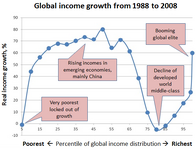
As shown the graph, globalization caused some of the world better off but also caused the US middle class to be worse off. Globalization did bring the super poor in China to be better off, which is a good thing for China. And it made the super rich in China and US better off. But it also unfortunately made the middle class in the US far worse off (mostly in the rust belt). And since the US had a robust middle class before globalization ( begun with the Clinton administration) it caused the US to decline in direct proportion to the China's rise.

So if you prefer the authoritative government of China to the so called US democracy, globalization has been good. But if you live in the US globalization has been very bad for most people who are not in the billionaire class.

It is a very nuanced argument that mostly depends where you live and what type of government you prefer.ft_cotw124.png
 
and yet in the end he cannot articulate anything wrong with capitalism.
Considering your past history of completely ignoring statements and facts contrary to your own pathetic opinion, I'll take the above with a huge mountain of salt.
+2 Agree with this.

Make your argument short and to the point. Leave out the bullshit and text unless someone thinks you are lying and wants to see more support.

Otherwise all your wall of text does is cause everyone's eyes to glaze over.
 
Dr. Wolff's lectures are strange.
But not as strange as your poll options.

I don't watch online video; Does he say anything more interesting than your threat of a further wall of text suggests?

FYI, everyone who knows of your posting history (except, perhaps, you) knows that the longer your posts, the less likely they are to include anything true.

You can even be succinct, on the rare occasions that you are not wrong.
I view those posts as proto-AI generated.
 
"Globalization" = a Win-Win,
not a conspiracy against "the Middle Class"


Globalization has winners and losers. The winners — particularly the upwardly mobile middle classes of China, India, Indonesia, Brazil, and Egypt — occupy the long hump of this elephant-like line. They have seen their inflation-adjusted incomes grow by 70 percent or more. The world's "1%" (which works out to the top 12 percent of the U.S., or households making more than $130,000) is also racing away with income, particularly at the tippy-top.

But the . . .
OK, maybe "globalization" did cause that, and yet all that is good. If there's anything wrong, it's only that the very super-rich ought to pay higher taxes on their part of this gain. But even so, this doesn't mean globalization did any net harm. It only means that we don't tax the super-rich enough.

But the story for the world's poorest percentiles has been the same as for the developed world's lower-middle class: No growth or worse.
No -- not "no growth" at all. But let's assume the net overall "growth" has been low for income-earners taken as a collective. But why is that? It's because of so many less competitive producers in those classes, and the globalization has been extra tough particularly on those who are less competitive. Which means that the solution is for the middle-class producers (the less competitive ones) to change and become more competitive, i.e., IMPROVE themselves.

Instead of whining that their uncompetitive jobs or businesses must be protected against the competition, they should be adjusting to the changes and doing whatever is necessary to improve their performance in the economy. Some of them need to start over, change careers, get themselves into more needed production where they can compete better, into production where there's more demand, instead of staying in something where the demand for them has declined. (Less demand = less value = lower compensation/income.)

And there are at least a few of those middle-class producers who did improve because they were competitive within the changed economy that resulted from globalization. You can't just bunch all those middle-class producers into the same category and say they all suffered from globalization. Some who were competitive did survive well and experienced upward change rather than downward, or at least stayed even. It's a fallacy to put them all together into the same boat. Those who are more competitive do experience the improved results.

The graph is a real print-and-saver, because even as we debate the sad geography of social mobility in the United States, the true geography of social mobility is global. And it has been a far happier story. The typical Chinese worker in 1988 was richer than only 10 percent of the globe's workers. Today he's richer than half the world. The typical Indian worker has moved from the 10th percentile to the 27th in the world; the Indonesian has gone from 25th to 39th; and in Brazil, from 40th to 66th.
Let's assume all that's correct. I.e., the "social mobility" has improved in some poorer countries, or in particular the ones more involved in the new global trade. But maybe not in the U.S.?, OK, let's assume that. But WHY did this happen?

As noted above, part of the explanation is that less competitive U.S. producers have not adjusted efficiently, as they should. And so they feel like "victims" of globalization -- and yet the solution is for them to take the initiative to improve themselves, to become more competitive, as mentioned above. But there's more to explain why the U.S. (or the U.S. "middle class") has had a bad outcome. It's not correct to blame it on "globalization" -- there are other negative elements in the U.S. which can better explain what might be the real culprit.

"Globalization" is not to blame.

As shown in the graph, globalization caused some of the world to be better off but also caused the US middle class to be worse off. Globalization did bring the super poor in China to be better off, which is a good thing for China. And it made the super rich in China and US better off. But it also unfortunately made the middle class in the US far worse off (mostly in the rust belt).
Maybe the above bad things did happen. But why assume globalization caused it? Maybe it did cause those better results in China. But some bad U.S. results can easily be explained by other factors. Or, the only bad result in the U.S. is that some uncompetitive producers got hurt by the new global competition. But that's not bad for the whole nation, because the more competitive producers were not hurt, or actually benefited. Which is what should happen: the better producers are rewarded, while the less competitive ones are penalized. So it's incorrect to say casually that "globalization caused . . . " etc. etc.

There are many other possible causes. Here are three bad factors in the U.S. economy which could more easily be blamed -- The U.S. is uniquely flawed as follows:

Lousy Education system -- Virtually the highest spender (per capita) on education, and yet with the lowest education outcomes among all developed countries;

Lousy Health Care system -- Again the highest spender on health care, and yet the worst outcomes among developed countries;

Lowest taxes on the wealthiest income-earners.

The first 2 above are problems not of over- or under-spending. Rather, these are inefficiency issues. Very bad decisions on how to spend the resources to improve education and health care. Stupid politicians/speechmakers making the decisions = bad results.

These ongoing flaws in the U.S. over a few decades could be doing severe damage to the whole economy, causing the living standards of many to decline.

Furthermore, it seems likely that ALL 3 of the above have gotten steadily worse, gradually, over the last 30 or 40 or 50 years. And gradual change, gradual decline, prolonged over decades, is likely to have long-term severe detrimental consequences.

Probably underinvestment in infrastructure is another flaw to add to this list. Among developed nations, the U.S. ranks low in this category also. Google Search says:
The United States has been underinvesting in its infrastructure for many decades, with the decline becoming particularly pronounced around the 1970s. It is not a recent phenomenon.
(Note: this decline began BEFORE Reagan, so don't blame it on Reaganomics, like Thom Hartmann always does.) So this is also a U.S. phenomenon of recent decades (70s to the present), along with the increased globalization. And this neglect of infrastructure is a much more likely explanation why many living standards have stagnated, rather than the globalization being the cause.

I'm tempted to add the gradually increasing PUBLIC DEBT, or rather deficits, to this list of U.S. flaws, but perhaps this same bad indebtedness trend is happening as much in other countries as in the U.S. So it's better to stick to the above 3 (maybe there are some other U.S. flaws also?). These 3 flaws are somewhat unique to the U.S. and appear to be getting worse and worse, gradually, going back through 50+ years. Reversing these bad trends is the solution.

And there's 3 more possible additions to this list of flaws: low public spending on social safety net programs, low spending on childcare programs, and low spending on pre-K schooling. However, it's difficult to determine if this is something recent (last 50 years or so), or if it was always a distinction of the U.S. compared to other developed countries. So the above 3 flaws are definite for this list, while others are less certain.

But there's no reason to add Globalization to this list of flaws. Maybe the U.S. has globalized more than other countries recently, but if anything this has been a net benefit to the U.S., not harm. And this benefit has likely offset (partly) the harm done by the above 3 U.S. flaws.

And since the US had a robust middle class before globalization (begun with the Clinton administration) it caused the US to decline in direct proportion to the China's rise.
"robust"?

No, it's not true that a China improvement has to translate into a U.S. decline, with the two inversely related. A more prosperous U.S. does not mean we need a China downfall. More free trade is a net benefit to both sides, to both buyers and sellers, to both importers and exporters. Also a net benefit to rich individuals and poor individuals, and also to rich countries and poor countries trading with each other. It's really a net benefit to the efficient producers and to consumers on both sides, and admittedly a net harm to some uncompetitive producers.

So the solution is to improve the performance of the less competitive producers, not punish consumers with higher prices. The point of the production is to serve consumers, not protect uncompetitive jobs. What good is a "robust" middle class if as producers their performance is substandard?

(The increased globalization more correctly began in the late 80s, not with Clinton.)


So if you prefer the authoritative government of China to the so-called US democracy, globalization has been good.
No, it's the reverse -- China has become less authoritative as a result of the increased trade after the Mao dictatorship. The Democracy movement in China was partly inspired by more contact between the 2 nations. More economic interaction has improved conditions for both populations. More economic competition between nations increases the living standards of all.

It required several decades of gradual improvement for South Korea to finally become democratic, with changes back and forth. And for China this process will necessarily be much longer. It's OK if this process of improvement happens gradually.

But if you live in the US globalization has been very bad for most people who are not in the billionaire class.
No, that's just more China-bashing for the xenophobic mindless masses who need scapegoats. The vast majority have benefited from globalization, i.e., as consumers. But it's true that many of the less competitive producers (e.g. in the rust belt) have been hurt because they did not adjust to the changing conditions. And they'll be hurt still further by the current bonehead Administration, promoting fossil fuel production and protecting the uncompetitive steelworkers and autoworkers in jobs where the labor costs are too high and more automation is making them obsolete.

It is a very nuanced argument that mostly depends on where you live and what type of government you prefer.
Sort of, in terms of the producers struggling to survive. But consumers everywhere are made better off by the increased competition we get with expanded trade. If there's a widening gap between rich and poor, the solution is higher taxation on the upper brackets. Or maybe some increased property taxes, or taxes on mansions or private jets, etc. -- Increased revenue, to pay for needed infrastructure that serves everyone.

Curtailing trade is no solution to anything, except to pacify xenophobes = short-term instant gratification only.
 
Last edited:
Lumpy said:
The United States has been underinvesting in its infrastructure for many decades, with the decline becoming particularly pronounced around the 1970s. It is not a recent phenomenon.
(Note: this decline began BEFORE Reagan, so don't blame it on Reaganomics, like Thom Hartmann always does.) So this is also a U.S. phenomenon of recent decades (70s to the present), along with the increased globalization. And this neglect of infrastructure is a much more likely explanation why many living standards have stagnated, rather than the globalization being the cause.
The decline started in the mid to late seventies due to the economic situation at the time. It was the age of oil embargoes and stagflation.

Reagan turned it into a political position, advocating for low taxes on the wealthy and government is too big when it is the government that creates a vast majority of the infrastructure

Trying to absolve Reagan for his part of the problem is anti historic.
 
But the story for the world's poorest percentiles has been the same as for the developed world's lower-middle class: No growth or worse.
No -- not "no growth" at all. But let's assume the net overall "growth" has been low for income-earners taken as a collective. But why is that? It's because of so many less competitive producers in those classes, and the globalization has been extra tough particularly on those who are less competitive. Which means that the solution is for the middle-class producers (the less competitive ones) to change and become more competitive, i.e., IMPROVE themselves.
How does (then 1950's era existing) US middle class compete with income-earners in China who can survive and live on an order of magnitude less? Who's fault is it (other than the US government) that US housing and food cost so much more than it does in China? Who's fault would it be (other than the US government) that regulations in the US prevent manufacturing from excessive pollution that isn't the case in China? How do you blame the US middle class for these conditions?

If you could somehow place a US worker and China worker in the same room doing the same operation. And then choose the worker who produced the most widgets with the same infrastructure as the most competitive. But that is not the way the world works today or even how it worked yesterday. In order for a US worker to out compete a China worker under your rules he would have to produce 10 times or more in the same amount of time. Or if a US worker could somehow import food and housing costs from China to his location but that can not possible either.

To eliminate the unfairness of this situation it is obviously necessary for the government to prevent this aforementioned unfair competition. The same way that the government has rules against monopolies and unfair stock trading.
 
The graph is a real print-and-saver, because even as we debate the sad geography of social mobility in the United States, the true geography of social mobility is global. And it has been a far happier story. The typical Chinese worker in 1988 was richer than only 10 percent of the globe's workers. Today he's richer than half the world. The typical Indian worker has moved from the 10th percentile to the 27th in the world; the Indonesian has gone from 25th to 39th; and in Brazil, from 40th to 66th.
Let's assume all that's correct. I.e., the "social mobility" has improved in some poorer countries, or in particular the ones more involved in the new global trade. But maybe not in the U.S.?, OK, let's assume that. But WHY did this happen?

As noted above, part of the explanation is that less competitive U.S. producers have not adjusted efficiently, as they should. And so they feel like "victims" of globalization -- and yet the solution is for them to take the initiative to improve themselves, to become more competitive, as mentioned above. But there's more to explain why the U.S. (or the U.S. "middle class") has had a bad outcome. It's not correct to blame it on "globalization" -- there are other negative elements in the U.S. which can better explain what might be the real culprit.

"Globalization" is not to blame.

As shown in the graph, globalization caused some of the world to be better off but also caused the US middle class to be worse off. Globalization did bring the super poor in China to be better off, which is a good thing for China. And it made the super rich in China and US better off. But it also unfortunately made the middle class in the US far worse off (mostly in the rust belt).
Maybe the above bad things did happen. But why assume globalization caused it? Maybe it did cause those better results in China. But some bad U.S. results can easily be explained by other factors. Or, the only bad result in the U.S. is that some uncompetitive producers got hurt by the new global competition. But that's not bad for the whole nation, because the more competitive producers were not hurt, or actually benefited. Which is what should happen: the better producers are rewarded, while the less competitive ones are penalized. So it's incorrect to say casually that "globalization caused . . . " etc. etc.

There are many other possible causes. Here are three bad factors in the U.S. economy which could more easily be blamed -- The U.S. is uniquely flawed as follows:

Lousy Education system -- Virtually the highest spender (per capita) on education, and yet with the lowest education outcomes among all developed countries;

Lousy Health Care system -- Again the highest spender on health care, and yet the worst outcomes among developed countries;

Lowest taxes on the wealthiest income-earners.

The first 2 above are problems not of over- or under-spending. Rather, these are inefficiency issues. Very bad decisions on how to spend the resources to improve education and health care. Stupid politicians/speechmakers making the decisions = bad results.

These ongoing flaws in the U.S. over a few decades could be doing severe damage to the whole economy, causing the living standards of many to decline.

Furthermore, it seems likely that ALL 3 of the above have gotten steadily worse, gradually, over the last 30 or 40 or 50 years. And gradual change, gradual decline, prolonged over decades, is likely to have long-term severe detrimental consequences.

Probably underinvestment in infrastructure is another flaw to add to this list. Among developed nations, the U.S. ranks low in this category also. Google Search says:
The United States has been underinvesting in its infrastructure for many decades, with the decline becoming particularly pronounced around the 1970s. It is not a recent phenomenon.
(Note: this decline began BEFORE Reagan, so don't blame it on Reaganomics, like Thom Hartmann always does.) So this is also a U.S. phenomenon of recent decades (70s to the present), along with the increased globalization. And this neglect of infrastructure is a much more likely explanation why many living standards have stagnated, rather than the globalization being the cause.

I'm tempted to add the gradually increasing PUBLIC DEBT, or rather deficits, to this list of U.S. flaws, but perhaps this same bad indebtedness trend is happening as much in other countries as in the U.S. So it's better to stick to the above 3 (maybe there are some other U.S. flaws also?). These 3 flaws are somewhat unique to the U.S. and appear to be getting worse and worse, gradually, going back through 50+ years. Reversing these bad trends is the solution.

And there's 3 more possible additions to this list of flaws: low public spending on social safety net programs, low spending on childcare programs, and low spending on pre-K schooling. However, it's difficult to determine if this is something recent (last 50 years or so), or if it was always a distinction of the U.S. compared to other developed countries. So the above 3 flaws are definite for this list, while others are less certain.

But there's no reason to add Globalization to this list of flaws. Maybe the U.S. has globalized more than other countries recently, but if anything this has been a net benefit to the U.S., not harm. And this benefit has likely offset (partly) the harm done by the above 3 U.S. flaws.

If you are saying that the US government needs to be more competitive then I agree with you. Right now as a starting point I would just be satisfied if the US government could be less corrupt than it is.

The Trump administration did attempt to implement DOGE but it was met with extreme hostility coming mostly from liberals and Democrats. So unfortunately, there are a lot of people who want the government to remain corrupt and inefficient as possible today. They want politicians like Nancy Pelosi and the Clintons to become centi-multi millionaires of of the tax paying public.
 
No, it's not true that a China improvement has to translate into a U.S. decline, with the two inversely related. A more prosperous U.S. does not mean we need a China downfall.
The mantra the Republicans love to sing, the pie can be grown bigger for everyone. But that's just not what happened. History proves the Republicans are full of shit and world manufacturing is indeed a zero sum game.

If one country manufactures a product, no one else needs to. China rose and US fell.
 
The Trump administration did attempt to implement DOGE but it was met with extreme hostility coming mostly from liberals and Democrats.
Yeah, if my car started consuming more fuel per mile, I would have extreme hostility to someone who tried to solve that problem by attacking the car with a fucking chainsaw.
So unfortunately, there are a lot of people who want the government to remain corrupt and inefficient as possible today.
One being the current President.
 
The graph is a real print-and-saver, because even as we debate the sad geography of social mobility in the United States, the true geography of social mobility is global. And it has been a far happier story. The typical Chinese worker in 1988 was richer than only 10 percent of the globe's workers. Today he's richer than half the world. The typical Indian worker has moved from the 10th percentile to the 27th in the world; the Indonesian has gone from 25th to 39th; and in Brazil, from 40th to 66th.
Let's assume all that's correct. I.e., the "social mobility" has improved in some poorer countries, or in particular the ones more involved in the new global trade. But maybe not in the U.S.?, OK, let's assume that. But WHY did this happen?

As noted above, part of the explanation is that less competitive U.S. producers have not adjusted efficiently, as they should. And so they feel like "victims" of globalization -- and yet the solution is for them to take the initiative to improve themselves, to become more competitive, as mentioned above. But there's more to explain why the U.S. (or the U.S. "middle class") has had a bad outcome. It's not correct to blame it on "globalization" -- there are other negative elements in the U.S. which can better explain what might be the real culprit.

"Globalization" is not to blame.

As shown in the graph, globalization caused some of the world to be better off but also caused the US middle class to be worse off. Globalization did bring the super poor in China to be better off, which is a good thing for China. And it made the super rich in China and US better off. But it also unfortunately made the middle class in the US far worse off (mostly in the rust belt).
Maybe the above bad things did happen. But why assume globalization caused it? Maybe it did cause those better results in China. But some bad U.S. results can easily be explained by other factors. Or, the only bad result in the U.S. is that some uncompetitive producers got hurt by the new global competition. But that's not bad for the whole nation, because the more competitive producers were not hurt, or actually benefited. Which is what should happen: the better producers are rewarded, while the less competitive ones are penalized. So it's incorrect to say casually that "globalization caused . . . " etc. etc.

There are many other possible causes. Here are three bad factors in the U.S. economy which could more easily be blamed -- The U.S. is uniquely flawed as follows:

Lousy Education system -- Virtually the highest spender (per capita) on education, and yet with the lowest education outcomes among all developed countries;

Lousy Health Care system -- Again the highest spender on health care, and yet the worst outcomes among developed countries;

Lowest taxes on the wealthiest income-earners.

The first 2 above are problems not of over- or under-spending. Rather, these are inefficiency issues. Very bad decisions on how to spend the resources to improve education and health care. Stupid politicians/speechmakers making the decisions = bad results.

These ongoing flaws in the U.S. over a few decades could be doing severe damage to the whole economy, causing the living standards of many to decline.

Furthermore, it seems likely that ALL 3 of the above have gotten steadily worse, gradually, over the last 30 or 40 or 50 years. And gradual change, gradual decline, prolonged over decades, is likely to have long-term severe detrimental consequences.

Probably underinvestment in infrastructure is another flaw to add to this list. Among developed nations, the U.S. ranks low in this category also. Google Search says:
The United States has been underinvesting in its infrastructure for many decades, with the decline becoming particularly pronounced around the 1970s. It is not a recent phenomenon.
(Note: this decline began BEFORE Reagan, so don't blame it on Reaganomics, like Thom Hartmann always does.) So this is also a U.S. phenomenon of recent decades (70s to the present), along with the increased globalization. And this neglect of infrastructure is a much more likely explanation why many living standards have stagnated, rather than the globalization being the cause.

I'm tempted to add the gradually increasing PUBLIC DEBT, or rather deficits, to this list of U.S. flaws, but perhaps this same bad indebtedness trend is happening as much in other countries as in the U.S. So it's better to stick to the above 3 (maybe there are some other U.S. flaws also?). These 3 flaws are somewhat unique to the U.S. and appear to be getting worse and worse, gradually, going back through 50+ years. Reversing these bad trends is the solution.

And there's 3 more possible additions to this list of flaws: low public spending on social safety net programs, low spending on childcare programs, and low spending on pre-K schooling. However, it's difficult to determine if this is something recent (last 50 years or so), or if it was always a distinction of the U.S. compared to other developed countries. So the above 3 flaws are definite for this list, while others are less certain.

But there's no reason to add Globalization to this list of flaws. Maybe the U.S. has globalized more than other countries recently, but if anything this has been a net benefit to the U.S., not harm. And this benefit has likely offset (partly) the harm done by the above 3 U.S. flaws.

If you are saying that the US government needs to be more competitive then I agree with you. Right now as a starting point I would just be satisfied if the US government could be less corrupt than it is.

The Trump administration did attempt to implement DOGE but it was met with extreme hostility coming mostly from liberals and Democrats. So unfortunately, there are a lot of people who want the government to remain corrupt and inefficient as possible today. They want politicians like Nancy Pelosi and the Clintons to become centi-multi millionaires of of the tax paying public.
Imagine that one is told that a company can be made more efficient if its paperwork was literally halved by cutting it in two (and for the purpose of this analogy that that is true). So have a pile of paperwork lying flat on a table, and a person comes along and slices it in two and throws away the unneeded paperwork, leaving the useful paperwork to be used; so greater efficiency.
But another person presented with the same situation, stacks the paperwork vertically, and then cuts through it, destroying all the paperwork, and that paperwork's effectiveness. That is what DOGE did. It was the opposite of efficient.
 
The graph is a real print-and-saver, because even as we debate the sad geography of social mobility in the United States, the true geography of social mobility is global. And it has been a far happier story. The typical Chinese worker in 1988 was richer than only 10 percent of the globe's workers. Today he's richer than half the world. The typical Indian worker has moved from the 10th percentile to the 27th in the world; the Indonesian has gone from 25th to 39th; and in Brazil, from 40th to 66th.
Let's assume all that's correct. I.e., the "social mobility" has improved in some poorer countries, or in particular the ones more involved in the new global trade. But maybe not in the U.S.?, OK, let's assume that. But WHY did this happen?

As noted above, part of the explanation is that less competitive U.S. producers have not adjusted efficiently, as they should. And so they feel like "victims" of globalization -- and yet the solution is for them to take the initiative to improve themselves, to become more competitive, as mentioned above. But there's more to explain why the U.S. (or the U.S. "middle class") has had a bad outcome. It's not correct to blame it on "globalization" -- there are other negative elements in the U.S. which can better explain what might be the real culprit.

"Globalization" is not to blame.

As shown in the graph, globalization caused some of the world to be better off but also caused the US middle class to be worse off. Globalization did bring the super poor in China to be better off, which is a good thing for China. And it made the super rich in China and US better off. But it also unfortunately made the middle class in the US far worse off (mostly in the rust belt).
Maybe the above bad things did happen. But why assume globalization caused it? Maybe it did cause those better results in China. But some bad U.S. results can easily be explained by other factors. Or, the only bad result in the U.S. is that some uncompetitive producers got hurt by the new global competition. But that's not bad for the whole nation, because the more competitive producers were not hurt, or actually benefited. Which is what should happen: the better producers are rewarded, while the less competitive ones are penalized. So it's incorrect to say casually that "globalization caused . . . " etc. etc.

There are many other possible causes. Here are three bad factors in the U.S. economy which could more easily be blamed -- The U.S. is uniquely flawed as follows:

Lousy Education system -- Virtually the highest spender (per capita) on education, and yet with the lowest education outcomes among all developed countries;

Lousy Health Care system -- Again the highest spender on health care, and yet the worst outcomes among developed countries;

Lowest taxes on the wealthiest income-earners.

The first 2 above are problems not of over- or under-spending. Rather, these are inefficiency issues. Very bad decisions on how to spend the resources to improve education and health care. Stupid politicians/speechmakers making the decisions = bad results.

These ongoing flaws in the U.S. over a few decades could be doing severe damage to the whole economy, causing the living standards of many to decline.

Furthermore, it seems likely that ALL 3 of the above have gotten steadily worse, gradually, over the last 30 or 40 or 50 years. And gradual change, gradual decline, prolonged over decades, is likely to have long-term severe detrimental consequences.

Probably underinvestment in infrastructure is another flaw to add to this list. Among developed nations, the U.S. ranks low in this category also. Google Search says:
The United States has been underinvesting in its infrastructure for many decades, with the decline becoming particularly pronounced around the 1970s. It is not a recent phenomenon.
(Note: this decline began BEFORE Reagan, so don't blame it on Reaganomics, like Thom Hartmann always does.) So this is also a U.S. phenomenon of recent decades (70s to the present), along with the increased globalization. And this neglect of infrastructure is a much more likely explanation why many living standards have stagnated, rather than the globalization being the cause.

I'm tempted to add the gradually increasing PUBLIC DEBT, or rather deficits, to this list of U.S. flaws, but perhaps this same bad indebtedness trend is happening as much in other countries as in the U.S. So it's better to stick to the above 3 (maybe there are some other U.S. flaws also?). These 3 flaws are somewhat unique to the U.S. and appear to be getting worse and worse, gradually, going back through 50+ years. Reversing these bad trends is the solution.

And there's 3 more possible additions to this list of flaws: low public spending on social safety net programs, low spending on childcare programs, and low spending on pre-K schooling. However, it's difficult to determine if this is something recent (last 50 years or so), or if it was always a distinction of the U.S. compared to other developed countries. So the above 3 flaws are definite for this list, while others are less certain.

But there's no reason to add Globalization to this list of flaws. Maybe the U.S. has globalized more than other countries recently, but if anything this has been a net benefit to the U.S., not harm. And this benefit has likely offset (partly) the harm done by the above 3 U.S. flaws.

If you are saying that the US government needs to be more competitive then I agree with you. Right now as a starting point I would just be satisfied if the US government could be less corrupt than it is.

The Trump administration did attempt to implement DOGE but it was met with extreme hostility coming mostly from liberals and Democrats. So unfortunately, there are a lot of people who want the government to remain corrupt and inefficient as possible today. They want politicians like Nancy Pelosi and the Clintons to become centi-multi millionaires of of the tax paying public.
Imagine that one is told that a company can be made more efficient if its paperwork was literally halved by cutting it in two (and for the purpose of this analogy that that is true). So have a pile of paperwork lying flat on a table, and a person comes along and slices it in two and throws away the unneeded paperwork, leaving the useful paperwork to be used; so greater efficiency.
But another person presented with the same situation, stacks the paperwork vertically, and then cuts through it, destroying all the paperwork, and that paperwork's effectiveness. That is what DOGE did. It was the opposite of efficient.
But the Democrats did not even want to be told where the corruption was. Never mind the chain saw act we saw courtesy Elon Musk. The liberals and Democrats did not even want to know about the obvious grafts and thievery uncovered by the messenger (Musk).

They want the US government to be corrupt. Especially when their Democrat congress people are caught being some of the corrupt mafia infesting our government.

In a better world, the first thing liberals should want from their government is honest politicians. They should be finding out how their congress leaders are becoming centi millionaires on a salary of 150k. Why did past POTUS Truman live in relative poverty after his presidency but players like Clinton and Obama (who also came from modest means) become multi centi-millionaires? A certain amount of corruption can always be expected but the US government has become so corrupt it makes the Roman senators of history look like mother Teresa. Our US federal government reminds me of East St. Louis where the politicians are corrupt they attempt election while serving in a jail cell. It would never occur to the average liberal that if their liberal representatives were actually beyond moral reproach (something similar to like J. Carter was) that MAGA might actually take serious some of their profuse law fare that gets thrown at Trump (who is also no doubt corrupt).

If the liberals are so interested in unequal and unfair wealth disparity why don't they start with their own players in congress? It is because the liberals love extreme government corruption. They love so called charity spending programs sending $billions everywhere but the US homeland. MAGA attempted to advertise some of this corruption but liberals shut it right down as fast as they could. Its because they like corruption and Chicago style mafia running our government.
 
Last edited:
But the Democrats did not even want to be told where the corruption was. Never mind the chain saw act we saw courtesy Elon Musk. The liberals and Democrats did not even want to know about the obvious grafts and thievery uncovered by the messenger (Musk).
Musk didn't uncover corruption, he created it.
RVonse said:
If the liberals are so interested in unequal and unfair wealth disparity why don't they start with their own players in congress? It is because the liberals love extreme government corruption. They love so called charity spending programs sending $billions everywhere but the US homeland. MAGA attempted to advertise some of this corruption but liberals shut it right down as fast as they could. Its because they like corruption and Chicago style mafia running our government.
Do you realize that the Republicans were in charge of Congress both prior to and during Trump's second term?
What can "liberals" do about Congressional pay when they have never been in control of the government? Liberals hate corruption. Republicans, especially MAGA, love it which is why you currently have the most corrupt government in the history of the USA.
Those "charity" programs, such as USAID, were doing useful soft power things for the USA and its reputation. It still had plenty of money it could have used on Americans but instead decided to give a trillion dollars to billionaires.

MAGA never attempt to oppose corruption, but support it, so it is liberals and leftists who expose it, but who lack power to actually prevent it, because even court rulings are disregarded by the current Trump administration.
You disregard reality if you think minor corruption by some Democrats is anywhere near the massive innate corruption of the Republicans. When the Democratic Party has evidence of corruption by one of their own they act to punish it, whereas the Republicans laud and support the same from any of them.
 
Those "charity" programs, such as USAID, were doing useful soft power things for the USA and its reputation.
Under Rump the US's rep is at a pre-World War low. Our alies, even Canada, are turning their backs on us. Rump is destroying everything that made us 'great'. Ironicly, China is becomming the new 'leader of the capatilist world'.
 
Back
Top Bottom