• Welcome to the Internet Infidels Discussion Board.

“Revolution in Thought: A new look at determinism and free will"

After all this time, you think I'm trying to pitch a product, and nothing more? I'm speechless!
To the point of not even denying the allegation, I note.
Of course I'm denying the allegation. That was implied in my comment. I am not here to sell a product. The suspicion here is getting out of hand.
 
The problem is that there are no physical means or mechanisms by which real time/ instant vision could work. It would have to be magic vision.
Incorrect. There is no gap if you see the object in real time, because it meets the requirements of size and luminosity. You keep assuming that, although light travels, it is bringing the image of the object to our eyes because the object reflected that lightwave. If the light does not bring the image to us through space/time, then how do we see without it violating physics? Efferent vision. You keep going back to the idea that when light strikes an object it takes on the object’s chacteristics, but that is not what is happening if Lessans is right. Light reveals. It is a necessary condition of sight, but it does not bring anything to us.

There is always a gap between light emission or reflection and information acquisition by the eyes, processing by the brain and conscious representation in the form of sight: we see the object.

That is basically how it works. No real time/ instant vision, just a physical process.
Nooo. You are missing the entire claim. Light travels, but the eyes and brain work differently than previously thought. You have to give this author a break, or you will just keep repeating the same old mantra that there is no way for us to see without light traveling to us with the image (sorry bilby, but this is the only way I can explain it). You will never get it if you keep thinking in these terms, not because he was wrong, but because you refuse to entertain the idea that there is no violation of physics.

Light in fact has speed and travel time. Light is in fact radiated by the sun, stars, etc, and reflected by the moon and other dark objects, the objects all around us during daylight hours are illuminated by the sun, and the moon and stars by night. We see these things because they either radiate or reflect light.

Without light we cannot see.
Right. Who is saying otherwise?
Go into a dark room and you see nothing, flip the light switch and there it all is, the room is illuminated.
Agreed.
It's as simple as that. The eyes acquire light, the brain generates vision. The eyes don't see, that is the function of the brain.
The brain focuses the eyes to see the real world. The brain doesn't generate vision.
Who is disputing this? The brain is involved, but it does not explain how this occurs. It's all theoretical, not fact!

You are disputing it with the claim of instant vision/seeing. Claiming that things like stars are seen instantly without the time lag between light emission and acquisition by the eyes and brain.

By making the claim, you are trying to bypass the fundamental principles of physics.
How many times have I said this version of sight does NOT violate physics? The reason we don't see stars without a time lag is the same reason we don't see the moon without a time lag. Distance is not as much a factor as size and luminosity. If a star exists but can't be seen because it is too far away, a telescope won't help. Any celestial body has to be visible, however faint, for a telescope to collect the light and magnify it. The ACTUAL star has to be visible, not just light that was emitted light-years earlier, which present-day thinking believes is all that is necessary. To repeat: The star has to be within the field of view of the telescope for it to collect the emitted light. It cannot magnify something that isn't there. IOW, if a star is too far away, and therefore too dim for it to be seen, a telescope won't be able to give us any new information.

Stars radiate light. That's how we are able to see them. Our eyes detect light from the stars and our brain generates mental imagery of them in conscious form. Stars are luminous because they emit light.
Stars radiate light, true, but they are also a mixture of plasma, hydrogen, and other gases. Light that is radiated from them allows us to see what they consist of: MATTER. If Lessans is right, the image of the star is not being sent to our telescopes from light-years in the past. We see the star because we have developed a telescope that is 9 times stronger than the Hubble and can magnify very dim light in order to be able to view the actual star.
 
Please stop using my words against me. It is easy to do...
Then you need to learn how to communicate better. FAR better. Or you have no hope of ever achieving anything at all in your entire life.
I've already achieved more than enough in my life thus far, but I certainly would like to achieve even more before I die. ;)
 
The Lessan's Theory Of Light And Seeing And Sound is debunked and falsified by theory evidenced by experiment. In turn the overall thesis is rejected.

de·bunk
/dēˈbəNGk/
verb
past tense: debunked; past participle: debunked

expose the falseness or hollowness of (a myth, idea, or belief).
"the magazine that debunks claims of the paranormal"

fal·si·fy
/ˈfôlsəˌfī,ˈfälsəˌfī/
verb
verb: falsify; 3rd person present: falsifies; past tense: falsified; past participle: falsified; gerund or present participle: falsifying

2. prove (a statement or theory) to be false.
“the hypothesis is falsified by the evidence"
 
This has got nothing to do with winning friends and influencing people. It has to do with the fact that the author’s claims are garbage.

If one could win friends and influence people to accept garbage claims, that is bad, not good.
These aren't garbage claims, and calling the claims garbage doesn't make them so. You are putting yourself too high on a pedestal by making yourself an arbiter of what is true and what isn't, when you don't have the knowledge to do that. You have never studied his work from day one. All you have ever done is tried to ruin him through laughter because you didn't like his claims.

This is so sadly typical of you.

It has nothing to do with whether I “like” his claims or not. Whether I “like” a claim or not is irrelevant to reality.
But you cannot determine this because you never studied his work in an unbiased way. You concluded he must be wrong because you believe science got it right, end of story.
I don’t “like” the fact that I am going to die, but I know that I am.
We all are, but you really didn't give his chapter on death a chance. The older we get, the more this knowledge can help give us a sense of peace.
I don’t like or dislike your author’s claims about light and sight. I just have the knowledge to know they are utter garbage, and that is all that matters.

It’s nothing personal.
Once again, the problem is with your very premise, in that it assumes he must be wrong because, in your mind, science must be right. You aren't questioning whether your conclusion could be wrong because of your premise being wrong. You assume. Assumptions are not facts.
 
Pg

You have 3 choices

1. Stop posting.
2. Continue posting ad infinitum.
3. Recognize the flaws in the book and redo your approach.
The major concepts are not flawed. How it is extended could always be improved upon.
You are modifying your approach a little. Saying his choice of words could have been better. He was not a scientist. But the revolutionary idea is still true.
He was a scientist of human behavior. How’s that?
To communicate an idea and get buy in you have to understand your audience and how they perceive you. Ten use a narrative in the context of perceptions.

Reagan was called the great commutator for a reason, he was skilled at communicating with regular people. Politicians have political consultants who figure out what to say to appeal to and concatenate with groups of people.
There is no way I could appeal to this group other than watering it down, and I did not want to do that.
Your approach is all wrong for the forum. Generally secular skeptics who like to debate and argue.

If you started with 'I realize that there are issues with the book but I think the occlusion has merit and would like to discuss it' things might have gone differently.
I would have loved people to read it and give me suggestions on making it more succinct or clearer, but I never got there.
You with 'This is true, all of it. And I will prove it'. So we debate your alleged proofs.

You need to add a lite give and take.
All I wanted to do was share his knowledge but no matter how I introduced his claim regarding the senses, I would have gotten slack. Same with his other claim.
So ends the post mortem analysis. Sometimes called lessons learned.

Have you leaned anything from all the posts?
I appreciate your feedback and I’m sorry that my presentation may not have been the best, but please understand my position that I was coming here to share a discovery, not to get them to agree if they don’t. But I never got that far. How can I move forward with an audience who refuses to read anything so we can have had a productive discussion, especially regarding his first discovery which shows how war and crime can be prevented. It’s ashame that not one person has asked any questions or wanted to know how it’s possible. I don’t know how I could have done anything more to create interest. It appears that skepticism has created a block that I cannot penetrate.

People have read the posted materials.

That is precisely why we disagree with the posted materials.
If they did read it, they didn't use his findings to reevaluate the present theory. They just fall back on their default position because it feels more comfortable.
 
Radar works by bouncing electromagnet radiation of an object. Bounce a signal of an arrplanee moving away and the tie for tr echo to return increases.

LIDAR can use visiblee light to find range to an object.

Ultrasonic ranging uses audacious waves to find range to an object.

Put two visible light lasers next each other pulsing burst of light. At two side by side receivers the pulses arve at the sen time. Move one of the lasers away on wheels and the pulses from the mongol laser will arrive after the stationary laser.

There is also the Doppler Effect.

Better telescopes do see fatter back in time. With Hubble areas of space tat looked dark or havnng few objects were found to be filled with objects.

I used to have a poster of the deep field in my office for inspiration. Along with a model of Chuck Yeager's Bell X1.


Hubble images
 
Last edited:
I have asked @peacegirl to do this.

To post a concise summary consisting of premises and a conclusion about her author’s argument to determinism and free will.

I have not asked to her to post such an argument about light and sight because her author’s claims in this respect are obvious garbage that cannot be sustained by any argument.

I tried to help peacegirl elucidate the author’s claims about determinism and free will in a formal manner. She rejected my help.

Can she do it herself?

No, she cannot.

Let’s see if she can prove me wrong.
I'm not taking up the challenge. This in no way means I don't understand the book. The only way I can continue is if I start from the beginning and go page by page. I don't think anyone even knows what his reasoning was as to why man's will is not free and why God knew what he was doing. That is not to be taken seriously, so don't get bent out of shape because I used the word God. :thinking:
 
Suggestions?

If Lessans had presented his ideas as a fictional story of a person and people enacting his philosophy we might be reading it today.

Scifi and other writers have presented their vision of society as fiction and garnered an audience.

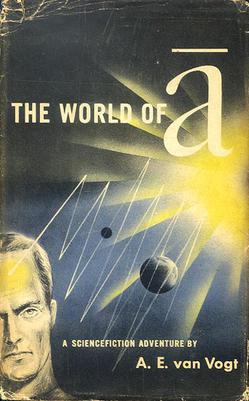
The Null-A series by A.E. van Vogt is a classic Golden Age science fiction trilogy focusing on non-Aristotelian logic, General Semantics, and superhuman abilities. Centered on protagonist Gilbert Gosseyn, the books explore themes of identity, evolution, and interstellar conspiracy.


Gilbert Gosseyn (pronounced go-sane), a man living in an apparent utopia where those with superior understanding and mental control rule the rest of humanity, wants to be tested by the giant Machine that determines such superiority. However, he finds that his memories are false. In his search for his real identity, he discovers that he has extra bodies that are activated when he dies (so that, in a sense, he cannot be killed), that a galactic society of humans exists outside the Solar System, a large interstellar empire wishes to conquer both the Earth and Venus (inhabited by masters of non-Aristotelian logic), and he has extra brain matter that, when properly trained, can allow him to move matter with his mind.

People may not realize how controversial the original Star Trek series was in the 60s. They framed social issues in scifi getting past the censors. And of course Twilight Zone, studies in humn nature.

Woulda Coulda Shoulda

The book is not fixable. It is pseudoscience.

You yourself can not speak to it, you dodge by saying it is too complex for words.
I never said it was too complex for words. I said that the concepts don't have a perfect word that would explain what he's talking about, so he used the word that came the closest. Why are you misinterpreting what I wrote?
 
I have asked @peacegirl to do this.

To post a concise summary consisting of premises and a conclusion about her author’s argument to determinism and free will.

I have not asked to her to post such an argument about light and sight because her author’s claims in this respect are obvious garbage that cannot be sustained by any argument.

I tried to help peacegirl elucidate the author’s claims about determinism and free will in a formal manner. She rejected my help.

Can she do it herself?

No, she cannot.

Let’s see if she can prove me wrong.
This has nothing to do with proving YOU wrong. It has everything to do with proving him RIGHT.
He's NOT right.

Once this natural law becomes a permanent condition of the environment, it will allow mankind, for the very first time, to veer in a different direction

Natural laws are, by definition, always and eternally permanent conditions of the environment.

They never allow anything "for the very first time".

Rocks didn't fall upwards before Newton made gravity a "permanent condition of the environment".
 
What? :oops: He did not say light bounces off and doesn't bounce off. Light is always traveling. The only thing that he disputes is that it does not take the object's wavelength with it.
Physical objects don't have a wavelength*. He had no clue what he was blathering about, and nor do you.


* at the macroscopic scales we are discussing. Quantum Field Theory this ain't.
 
They reasoned that since it takes longer for the sound from an airplane to reach us when 15,000 feet away than when 5000; and since it takes longer for light to reach us the farther it is away when starting its journey, light and sound must function alike in other respects
Literally nobody reasoned this. "They" are a figment of his imagination, and this is a classic strawman logical fallacy.
 
If Lessans is right,
He isn't, and your assuming that he is is the logical fallacy of question begging.
the image of the star is not being sent
Nothing is being 'sent'; It is just travelling light.
to our telescopes
And it is going everywhere; Light radiates out from stars in all directions.
from light-years in the past.
A light-year is not a measure of time, it is a measure of distance.

You might as well say "from kilometres in the past".
 
Last edited:
We all are, but you really didn't give his chapter on death a chance. The older we get, the more this knowledge can help give us a sense of peace.

Oh, yes, I forgot, when we die we are reborn as someone else. That’s why he advised Jews to quit bitching about the Holocaust, because they are still alive as someone else.

As it happens this is also basically the thesis of Tom Clark at naturalism.org. I tried to help you with that, too, and even put you in touch with him to present you writer’s ideas, which predated Clark’s own, but you threw a big tantrum and said No. So, fine. This all happened back at FF.

I don’t like or dislike your author’s claims about light and sight. I just have the knowledge to know they are utter garbage, and that is all that matters.

It’s nothing personal.
Once again, the problem is with your very premise, in that it assumes he must be wrong because, in your mind, science must be right. You aren't questioning whether your conclusion could be wrong because of your premise being wrong. You assume. Assumptions are not facts.

Nope, wrong again. I assume nothing. I go by the evidence.

Virtually hundreds of experiments, some of which you can do on your own, rule out real-time seeing.

As mentioned, go watch the sun rise in the morning. What happens when it does completely disconfirms your author’s claims.
 
If they did read it, they didn't use his findings to reevaluate the present theory. They just fall back on their default position because it feels more comfortable. there are no repeatable findings, and so no reason to reevaluate
FTFY.

Your paranoia notwithstanding, science simply does not reject (or accept) findings on the basis of dogma, but rather on the basis of repeatability.

If you present an experimental method that anyone can reproduce and see the results for themselves*, then you will force science to be reevaluated. This is how science works, and people who overturn the "default position" are not shunned, they are lauded. If there were anything real in his claims about light, he would have won a Nobel for his work. But he didn't because there isn't.


* Something you steadfastly refuse to even attempt
 
I have asked @peacegirl to do this.

To post a concise summary consisting of premises and a conclusion about her author’s argument to determinism and free will.

I have not asked to her to post such an argument about light and sight because her author’s claims in this respect are obvious garbage that cannot be sustained by any argument.

I tried to help peacegirl elucidate the author’s claims about determinism and free will in a formal manner. She rejected my help.

Can she do it herself?

No, she cannot.

Let’s see if she can prove me wrong.
I'm not taking up the challenge. This in no way means I don't understand the book. The only way I can continue is if I start from the beginning and go page by page. I don't think anyone even knows what his reasoning was as to why man's will is not free and why God knew what he was doing. That is not to be taken seriously, so don't get bent out of shape because I used the word God. :thinking:

You’re not taking up the challenge because you can’t meet it, which means you got nuthin’.

As a matter of face I DO understand your author’s argument about free will and determinism, and can effortlessly present an argument with premises and a conclusion to elucidate it.
 
I have asked @peacegirl to do this.

To post a concise summary consisting of premises and a conclusion about her author’s argument to determinism and free will.

I have not asked to her to post such an argument about light and sight because her author’s claims in this respect are obvious garbage that cannot be sustained by any argument.

I tried to help peacegirl elucidate the author’s claims about determinism and free will in a formal manner. She rejected my help.

Can she do it herself?

No, she cannot.

Let’s see if she can prove me wrong.
I'm not taking up the challenge.
No surprise there.
This in no way means I don't understand the book.
Yeah, it probably does. It certainly looks that way.
The only way I can continue is if I start from the beginning and go page by page.
Yeah, that's not needed if you actually understand a text.
I don't think anyone even knows what his reasoning was as to why man's will is not free and why God knew what he was doing.
Inculding you. Bevause there was no reasoning, just blather.
That is not to be taken seriously, so don't get bent out of shape because I used the word God. :thinking:
Don't worry, nobody here will take you seriously at this point.
 
Back
Top Bottom